Buffalo Exchange Impact Tracker
Buffalo Exchange Impact Tracker
Mobile Product Design · Concept Project UX Research · Product Strategy · Behavior Design · Mobile UI
Mobile Product Design · Concept Project UX Research · Product Strategy · Behavior Design · Mobile UI
My Role
UX Researcher · Product Designer
User interviews · Persona development · Secondary research
Methods
Timeline
3 months
Focus
Behavior change · Sustainability
· Gamification

Background
Encouraging Sustainable Shopping Through Visible Impact
Buffalo Exchange has built its brand around resale fashion and sustainability. Every secondhand purchase helps reduce waste, conserve resources, and extend the life of existing clothing.
Yet despite growing awareness of environmental issues, many consumers continue to choose fast fashion over resale alternatives.
This project explored a simple question: How might we help shoppers see the impact of their choices and motivate them to continue choosing resale over fast fashion?
The result was a mobile app concept designed to encourage sustainable shopping habits by making environmental impact visible, measurable, and rewarding.
At its core, the project explored how product design can bridge the gap between what people value and how they actually behave.
The Challenge
Sustainability without feedback doesn't stick
Resale shopping is objectively better for the environment. However, the benefits often feel distant and difficult to measure.
Many shoppers care deeply about sustainability, yet they rarely receive feedback showing how their individual choices contribute to larger environmental outcomes.
For younger consumers especially, the immediate rewards of fast fashion (lower prices, convenience, and trend accessibility) often outweigh abstract environmental benefits.
Without visible progress, sustainable shopping can feel insignificant.
The challenge wasn't simply educating users about sustainability. Most shoppers already understood the issue.
The real challenge was encouraging long-term behavior change in a way that felt motivating rather than guilt-driven.
How might we make sustainability feel personal, rewarding, and worth returning to?
Understanding the Users
Awareness Alone Doesn't Change Behavior
Participants already understood that secondhand shopping was better for the environment.
The problem wasn't awareness. The problem was that sustainability felt too abstract and disconnected from everyday purchasing decisions.
Without feedback, many shoppers struggled to see whether their efforts mattered.
Users already cared about sustainability, but they lacked feedback mechanisms that could help turn good intentions into lasting habits.
Progress Creates Motivation
Participants responded positively to the idea of tracking their impact over time.
Users wanted evidence that their choices mattered. Visible progress created a stronger sense of accomplishment and motivation.
Tracking progress also transformed sustainability from a one-time decision into an ongoing journey.
Identity Reinforces Behavior
For many shoppers, especially younger participants, sustainability was closely tied to personal values and self-expression.
Participants were more excited about sustainability when it became part of how they saw themselves rather than simply another statistic.
Shareable milestones and achievements had the potential to strengthen that identity.
Research Approach
To better understand the motivations and barriers behind resale shopping, our team conducted interviews with 14 Buffalo Exchange shoppers across a range of ages and shopping habits.
The interviews explored:
Why people choose resale over traditional retail
What motivates repeat visits
How sustainability influences purchasing decisions
What barriers prevent more consistent resale shopping
While participants overwhelmingly supported sustainability and circular fashion, many struggled to connect their individual purchases to meaningful environmental impact.
Research Overview | |
|---|---|
Methods | 14 User Interviews · Affinity Mapping · Persona Development · Opportunity Mapping |
Participants | College Students · Adult Buffalo Exchange Shoppers |
Goal | Understand how sustainability influences shopping behavior and identify opportunities to encourage long-term engagement with resale fashion. |
Key Insight | People wanted to make sustainable choices, but rarely received feedback showing that those choices mattered. |

Opportunity Areas
Research Approach
To better understand the motivations and barriers behind resale shopping, our team conducted interviews with 14 Buffalo Exchange shoppers across a range of ages and shopping habits.
The interviews explored:
Why people choose resale over traditional retail
What motivates repeat visits
How sustainability influences purchasing decisions
What barriers prevent more consistent resale shopping
While participants overwhelmingly supported sustainability and circular fashion, many struggled to connect their individual purchases to meaningful environmental impact.
Research Overview | |
|---|---|
Methods | 14 User Interviews · Affinity Mapping · Persona Development · Opportunity Mapping |
Participants | College Students · Adult Buffalo Exchange Shoppers |
Goal | Understand how sustainability influences shopping behavior and identify opportunities to encourage long-term engagement with resale fashion. |
Key Insight | People wanted to make sustainable choices, but rarely received feedback showing that those choices mattered. |
Research Approach
To better understand the motivations and barriers behind resale shopping, our team conducted interviews with 14 Buffalo Exchange shoppers across a range of ages and shopping habits.
The interviews explored:
Why people choose resale over traditional retail
What motivates repeat visits
How sustainability influences purchasing decisions
What barriers prevent more consistent resale shopping
While participants overwhelmingly supported sustainability and circular fashion, many struggled to connect their individual purchases to meaningful environmental impact.
Research Overview | |
|---|---|
Methods | 14 User Interviews · Affinity Mapping · Persona Development · Opportunity Mapping |
Participants | College Students · Adult Buffalo Exchange Shoppers |
Goal | Understand how sustainability influences shopping behavior and identify opportunities to encourage long-term engagement with resale fashion. |
Key Insight | People wanted to make sustainable choices, but rarely received feedback showing that those choices mattered. |


Research Approach
To better understand the motivations and barriers behind resale shopping, our team conducted interviews with 14 Buffalo Exchange shoppers across a range of ages and shopping habits.
The interviews explored:
Why people choose resale over traditional retail
What motivates repeat visits
How sustainability influences purchasing decisions
What barriers prevent more consistent resale shopping
While participants overwhelmingly supported sustainability and circular fashion, many struggled to connect their individual purchases to meaningful environmental impact.
Research Overview | |
|---|---|
Methods | 14 User Interviews · Affinity Mapping · Persona Development · Opportunity Mapping |
Participants | College Students · Adult Buffalo Exchange Shoppers |
Goal | Understand how sustainability influences shopping behavior and identify opportunities to encourage long-term engagement with resale fashion. |
Key Insight | People wanted to make sustainable choices, but rarely received feedback showing that those choices mattered. |
Awareness Alone Doesn't Change Behavior
Participants already understood that secondhand shopping was better for the environment.
The problem wasn't awareness. The problem was that sustainability felt too abstract and disconnected from everyday purchasing decisions.
Without feedback, many shoppers struggled to see whether their efforts mattered.
Users already cared about sustainability, but they lacked feedback mechanisms that could help turn good intentions into lasting habits.
Progress Creates Motivation
Participants responded positively to the idea of tracking their impact over time.
Users wanted evidence that their choices mattered. Visible progress created a stronger sense of accomplishment and motivation.
Tracking progress also transformed sustainability from a one-time decision into an ongoing journey.
Identity Reinforces Behavior
For many shoppers, especially younger participants, sustainability was closely tied to personal values and self-expression.
Participants were more excited about sustainability when it became part of how they saw themselves rather than simply another statistic.
Shareable milestones and achievements had the potential to strengthen that identity.
Key Insights that Shaped the Product Strategy
Awareness Alone Doesn't Change Behavior
Participants already understood that secondhand shopping was better for the environment.
The problem wasn't awareness. The problem was that sustainability felt too abstract and disconnected from everyday purchasing decisions.
Without feedback, many shoppers struggled to see whether their efforts mattered.
Users already cared about sustainability, but they lacked feedback mechanisms that could help turn good intentions into lasting habits.
Progress Creates Motivation
Participants responded positively to the idea of tracking their impact over time.
Users wanted evidence that their choices mattered. Visible progress created a stronger sense of accomplishment and motivation.
Tracking progress also transformed sustainability from a one-time decision into an ongoing journey.
Identity Reinforces Behavior
For many shoppers, especially younger participants, sustainability was closely tied to personal values and self-expression.
Participants were more excited about sustainability when it became part of how they saw themselves rather than simply another statistic.
Shareable milestones and achievements had the potential to strengthen that identity.

From Research to Design
Opportunity Areas
Opportunity Areas

Product Strategy

From Research to Design
From Research to Design
Product Strategy
Product Strategy
The central design question became: What does a person need to feel in order to choose resale again next time?
Interviews revealed that awareness wasn't the problem. Most participants already understood the environmental benefits of resale shopping.
What they lacked was evidence that their individual actions mattered.
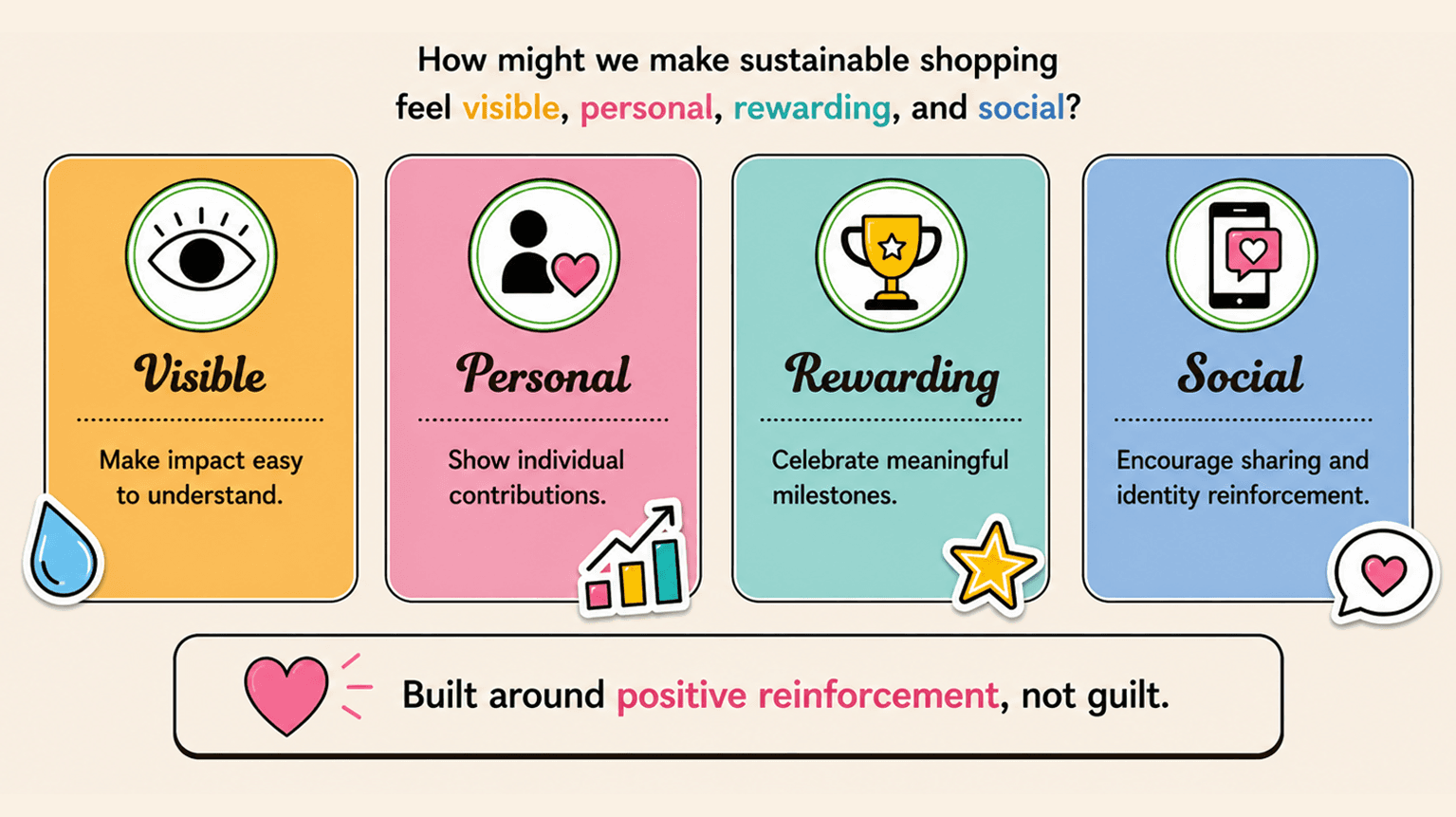
To address this, the experience was built around four strategic principles.
Design Process
Exploring Early Concepts
Initial ideation explored several approaches to encouraging sustainable shopping, including community challenges, leaderboards, educational content, and personal impact tracking.
As concepts evolved, personal impact tracking consistently emerged as the strongest opportunity.
Rather than relying on competition or guilt-based messaging, the final direction focused on positive reinforcement and progress visualization.
This approach aligned most closely with the motivations uncovered during research.

The site map organized the experience
around four core areas: impact tracking, rewards,events, and in-store interactions.
This structure helped create clear pathways between user goals and key features.

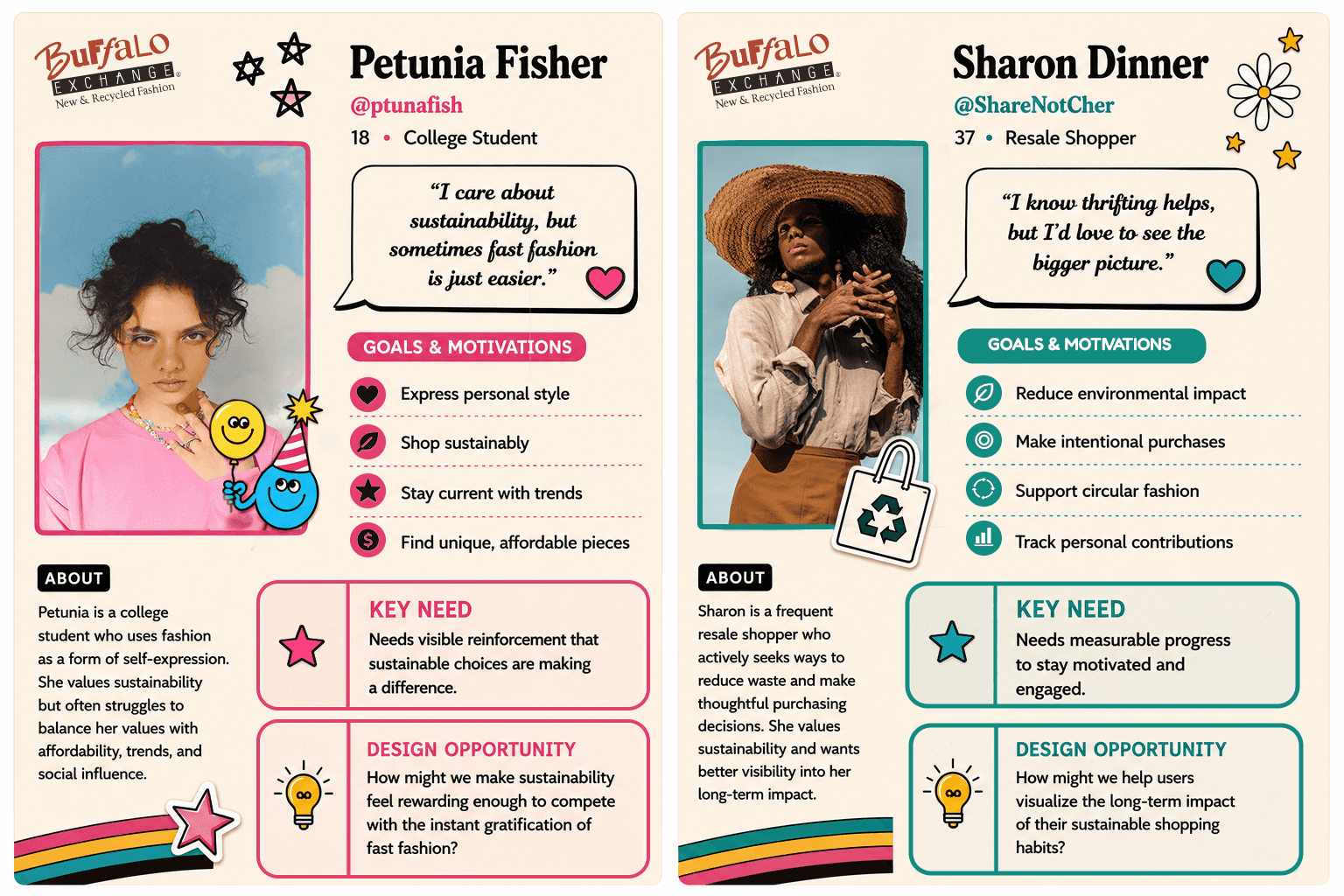
Journey maps explored two distinct user motivations. Sharon focused on tracking impact and redeeming rewards, while Petunia's journey centered on event discovery, badge collection, impact tracking, and sharing achievements.
Sharon: Impact-driven user focused on tracking progress and redeeming rewards.
Petunia: Community-oriented user motivated by events, badges, and social sharing.

Low-fidelity wireframes explored navigation, feature hierarchy, and the relationship between rewards, impact tracking, and social sharing before visual design was introduced.

Mid-fidelity wireframes refined the user flow and content hierarchy while introducing the first iterations of the impact dashboard, rewards system, event discovery features, and thrift tag sharing experience.
Design Process
Design Process
Product Strategy
The central design question became: What does a person need to feel in order to choose resale again next time?
Interviews revealed that awareness wasn't the problem. Most participants already understood the environmental benefits of resale shopping.
What they lacked was evidence that their individual actions mattered.
To address this, the experience was built around four strategic principles.
The central design question became: What does a person need to feel in order to choose resale again next time?
Interviews revealed that awareness wasn't the problem. Most participants already understood the environmental benefits of resale shopping.
What they lacked was evidence that their individual actions mattered.
To address this, the experience was built around four strategic principles.
Product Strategy
Final Product
Final Product
Final Product
Personal Impact Dashboard
The dashboard serves as the primary entry point to the experience.
Users can instantly view the cumulative environmental impact of their purchases through simple metrics and relatable equivalents.
The goal was immediate understanding and reinforcement.
Users should be able to recognize their contribution within seconds of opening the app.

Impact History
A timeline view allows users to track their contributions over time.
By visualizing progress across weeks, months, and years, users can better connect individual purchases to meaningful long-term outcomes.
This feature was designed to support habit formation and ongoing engagement.

Milestones & Rewards
Achievement badges celebrate meaningful sustainability milestones.
Rather than rewarding app usage alone, milestones are tied directly to environmental contributions generated through resale purchases.
This creates a stronger connection between action and recognition.

Shareable Impact Summaries
Inspired by familiar recap experiences, this feature transforms sustainability achievements into visually engaging summaries.
Users can celebrate milestones, share progress with friends, and reinforce their identity as sustainable shoppers.
Design Process
Exploring Early Concepts
Initial ideation explored several approaches to encouraging sustainable shopping, including community challenges, leaderboards, educational content, and personal impact tracking.
As concepts evolved, personal impact tracking consistently emerged as the strongest opportunity.
Rather than relying on competition or guilt-based messaging, the final direction focused on positive reinforcement and progress visualization.
This approach aligned most closely with the motivations uncovered during research.
Exploring Early Concepts
Initial ideation explored several approaches to encouraging sustainable shopping, including community challenges, leaderboards, educational content, and personal impact tracking.
As concepts evolved, personal impact tracking consistently emerged as the strongest opportunity.
Rather than relying on competition or guilt-based messaging, the final direction focused on positive reinforcement and progress visualization.
This approach aligned most closely with the motivations uncovered during research.

Final Designs
The final designs brought the experience to life through personalized impact tracking, rewards, community events, and social sharing, transforming sustainable shopping into a more engaging and rewarding experience.


A Day in Petunia's Experience
Petunia begins on her dashboard, searches for a community event, redeems points for a new badge, explores her personal impact metrics, and shares her thrift tag with friends. This flow demonstrates how rewards, impact visualization, and social connection work together to motivate ongoing engagement.
Reflection
The site map organized the experience
around four core areas: impact tracking, rewards,events, and in-store interactions.
This structure helped create clear pathways between user goals and key features.
Journey maps explored two distinct user motivations. Sharon focused on tracking impact and redeeming rewards, while Petunia's journey centered on event discovery, badge collection, impact tracking, and sharing achievements.
Sharon: Impact-driven user focused on tracking progress and redeeming rewards.
Petunia: Community-oriented user motivated by events, badges, and social sharing.
Low-fidelity wireframes explored navigation, feature hierarchy, and the relationship between rewards, impact tracking, and social sharing before visual design was introduced.
Final Product
Reflection
Mid-fidelity wireframes refined the user flow and content hierarchy while introducing the first iterations of the impact dashboard, rewards system, event discovery features, and thrift tag sharing experience.
Journey maps explored two distinct user motivations. Sharon focused on tracking impact and redeeming rewards, while Petunia's journey centered on event discovery, badge collection, impact tracking, and sharing achievements.
Sharon: Impact-driven user focused on tracking progress and redeeming rewards.
Petunia: Community-oriented user motivated by events, badges, and social sharing.
Low-fidelity wireframes explored navigation, feature hierarchy, and the relationship between rewards, impact tracking, and social sharing before visual design was introduced.
Journey maps explored two distinct user motivations. Sharon focused on tracking impact and redeeming rewards, while Petunia's journey centered on event discovery, badge collection, impact tracking, and sharing achievements.
Sharon: Impact-driven user focused on tracking progress and redeeming rewards.
Petunia: Community-oriented user motivated by events, badges, and social sharing.
Mid-fidelity wireframes refined the user flow and content hierarchy while introducing the first iterations of the impact dashboard, rewards system, event discovery features, and thrift tag sharing experience.
Low-fidelity wireframes explored navigation, feature hierarchy, and the relationship between rewards, impact tracking, and social sharing before visual design was introduced.
The site map organized the experience
around four core areas: impact tracking, rewards,events, and in-store interactions.
This structure helped create clear pathways between user goals and key features.
Final Product
Reflection
Final Product
Reflection
Reflection
Mid-fidelity wireframes refined the user flow and content hierarchy while introducing the first iterations of the impact dashboard, rewards system, event discovery features, and thrift tag sharing experience.
Impact History
A timeline view allows users to track their contributions over time.
By visualizing progress across weeks, months, and years, users can better connect individual purchases to meaningful long-term outcomes.
This feature was designed to support habit formation and ongoing engagement.
Milestones & Rewards
Achievement badges celebrate meaningful sustainability milestones.
Rather than rewarding app usage alone, milestones are tied directly to environmental contributions generated through resale purchases.
This creates a stronger connection between action and recognition.
The site map organized the experience
around four core areas: impact tracking, rewards,events, and in-store interactions.
This structure helped create clear pathways between user goals and key features.
This project reinforced an important lesson: Awareness alone rarely changes behavior.
Most participants already understood the environmental impact of fast fashion. What they lacked was visible reinforcement that their individual actions mattered.
The most valuable takeaway wasn't about sustainability, it was about behavior change.
People are more likely to maintain positive habits when they can see their progress, celebrate milestones, and connect their actions to their identity.
By making sustainability visible, personal, rewarding, and social, the product aims to bridge the gap between sustainable values and sustainable behavior.
Given additional time, the next phase would include usability testing with Buffalo Exchange shoppers, integration with point-of-sale systems to automate impact tracking, and longitudinal research to evaluate whether the experience meaningfully influences purchasing behavior over time.
While this project began as a concept, it demonstrates how research-driven design can be used to support behavior change and create more engaging sustainability experiences.
Shareable Impact Summaries
Inspired by familiar recap experiences, this feature transforms sustainability achievements into visually engaging summaries.
Users can celebrate milestones, share progress with friends, and reinforce their identity as sustainable shoppers.
A Day in Petunia's Experience
Impact History
A timeline view allows users to track their contributions over time.
By visualizing progress across weeks, months, and years, users can better connect individual purchases to meaningful long-term outcomes.
This feature was designed to support habit formation and ongoing engagement.
Milestones & Rewards
Achievement badges celebrate meaningful sustainability milestones.
Rather than rewarding app usage alone, milestones are tied directly to environmental contributions generated through resale purchases.
This creates a stronger connection between action and recognition.
Milestones & Rewards
Achievement badges celebrate meaningful sustainability milestones.
Rather than rewarding app usage alone, milestones are tied directly to environmental contributions generated through resale purchases.
This creates a stronger connection between action and recognition.
Impact History
A timeline view allows users to track their contributions over time.
By visualizing progress across weeks, months, and years, users can better connect individual purchases to meaningful long-term outcomes.
This feature was designed to support habit formation and ongoing engagement.
Shareable Impact Summaries
Inspired by familiar recap experiences, this feature transforms sustainability achievements into visually engaging summaries.
Users can celebrate milestones, share progress with friends, and reinforce their identity as sustainable shoppers.
Shareable Impact Summaries
Inspired by familiar recap experiences, this feature transforms sustainability achievements into visually engaging summaries.
Users can celebrate milestones, share progress with friends, and reinforce their identity as sustainable shoppers.
Petunia begins on her dashboard, searches for a community event, redeems points for a new badge, explores her personal impact metrics, and shares her thrift tag with friends. This flow demonstrates how rewards, impact visualization, and social connection work together to motivate ongoing engagement.
A Day in Petunia's Experience
Final Designs
The final designs brought the experience to life through personalized impact tracking, rewards, community events, and social sharing, transforming sustainable shopping into a more engaging and rewarding experience.
A Day in Petunia's Experience
Petunia begins on her dashboard, searches for a community event, redeems points for a new badge, explores her personal impact metrics, and shares her thrift tag with friends. This flow demonstrates how rewards, impact visualization, and social connection work together to motivate ongoing engagement.
Petunia begins on her dashboard, searches for a community event, redeems points for a new badge, explores her personal impact metrics, and shares her thrift tag with friends. This flow demonstrates how rewards, impact visualization, and social connection work together to motivate ongoing engagement.
Final Designs
The final designs brought the experience to life through personalized impact tracking, rewards, community events, and social sharing, transforming sustainable shopping into a more engaging and rewarding experience.
Personal Impact Dashboard
The dashboard serves as the primary entry point to the experience.
Users can instantly view the cumulative environmental impact of their purchases through simple metrics and relatable equivalents.
The goal was immediate understanding and reinforcement.
Users should be able to recognize their contribution within seconds of opening the app.
Impact History
A timeline view allows users to track their contributions over time.
By visualizing progress across weeks, months, and years, users can better connect individual purchases to meaningful long-term outcomes.
This feature was designed to support habit formation and ongoing engagement.
Milestones & Rewards
Achievement badges celebrate meaningful sustainability milestones.
Rather than rewarding app usage alone, milestones are tied directly to environmental contributions generated through resale purchases.
This creates a stronger connection between action and recognition.
Shareable Impact Summaries
Inspired by familiar recap experiences, this feature transforms sustainability achievements into visually engaging summaries.
Users can celebrate milestones, share progress with friends, and reinforce their identity as sustainable shoppers.
Final Product
Personal Impact Dashboard
The dashboard serves as the primary entry point to the experience.
Users can instantly view the cumulative environmental impact of their purchases through simple metrics and relatable equivalents.
The goal was immediate understanding and reinforcement.
Users should be able to recognize their contribution within seconds of opening the app.
Final Designs
The final designs brought the experience to life through personalized impact tracking, rewards, community events, and social sharing, transforming sustainable shopping into a more engaging and rewarding experience.



Buffalo Exchange Impact Tracker
Buffalo Exchange Impact Tracker
Mobile Product Design · Concept Project UX Research · Product Strategy · Behavior Design · Mobile UI
Mobile Product Design · Concept Project UX Research · Product Strategy · Behavior Design · Mobile UI
My Role
UX Researcher · Product Designer
User interviews · Persona development · Secondary research
Methods
Timeline
3 months
Focus
Behavior change · Sustainability
· Gamification
Background
Encouraging Sustainable Shopping Through Visible Impact
Buffalo Exchange has built its brand around resale fashion and sustainability. Every secondhand purchase helps reduce waste, conserve resources, and extend the life of existing clothing.
Yet despite growing awareness of environmental issues, many consumers continue to choose fast fashion over resale alternatives.
This project explored a simple question: How might we help shoppers see the impact of their choices and motivate them to continue choosing resale over fast fashion?
The result was a mobile app concept designed to encourage sustainable shopping habits by making environmental impact visible, measurable, and rewarding.
At its core, the project explored how product design can bridge the gap between what people value and how they actually behave.
The Challenge
Sustainability without feedback doesn't stick
Resale shopping is objectively better for the environment. However, the benefits often feel distant and difficult to measure.
Many shoppers care deeply about sustainability, yet they rarely receive feedback showing how their individual choices contribute to larger environmental outcomes.
For younger consumers especially, the immediate rewards of fast fashion (lower prices, convenience, and trend accessibility) often outweigh abstract environmental benefits.
Without visible progress, sustainable shopping can feel insignificant.
The challenge wasn't simply educating users about sustainability. Most shoppers already understood the issue.
The real challenge was encouraging long-term behavior change in a way that felt motivating rather than guilt-driven.
How might we make sustainability feel personal, rewarding, and worth returning to?
Understanding the Users
Awareness Alone Doesn't Change Behavior
Participants already understood that secondhand shopping was better for the environment.
The problem wasn't awareness. The problem was that sustainability felt too abstract and disconnected from everyday purchasing decisions.
Without feedback, many shoppers struggled to see whether their efforts mattered.
Users already cared about sustainability, but they lacked feedback mechanisms that could help turn good intentions into lasting habits.
Progress Creates Motivation
Participants responded positively to the idea of tracking their impact over time.
Users wanted evidence that their choices mattered. Visible progress created a stronger sense of accomplishment and motivation.
Tracking progress also transformed sustainability from a one-time decision into an ongoing journey.
Identity Reinforces Behavior
For many shoppers, especially younger participants, sustainability was closely tied to personal values and self-expression.
Participants were more excited about sustainability when it became part of how they saw themselves rather than simply another statistic.
Shareable milestones and achievements had the potential to strengthen that identity.
Research Approach
To better understand the motivations and barriers behind resale shopping, our team conducted interviews with 14 Buffalo Exchange shoppers across a range of ages and shopping habits.
The interviews explored:
Why people choose resale over traditional retail
What motivates repeat visits
How sustainability influences purchasing decisions
What barriers prevent more consistent resale shopping
While participants overwhelmingly supported sustainability and circular fashion, many struggled to connect their individual purchases to meaningful environmental impact.
Research Overview | |
|---|---|
Methods | 14 User Interviews · Affinity Mapping · Persona Development · Opportunity Mapping |
Participants | College Students · Adult Buffalo Exchange Shoppers |
Goal | Understand how sustainability influences shopping behavior and identify opportunities to encourage long-term engagement with resale fashion. |
Key Insight | People wanted to make sustainable choices, but rarely received feedback showing that those choices mattered. |
Opportunity Areas
Research Approach
To better understand the motivations and barriers behind resale shopping, our team conducted interviews with 14 Buffalo Exchange shoppers across a range of ages and shopping habits.
The interviews explored:
Why people choose resale over traditional retail
What motivates repeat visits
How sustainability influences purchasing decisions
What barriers prevent more consistent resale shopping
While participants overwhelmingly supported sustainability and circular fashion, many struggled to connect their individual purchases to meaningful environmental impact.
Research Overview | |
|---|---|
Methods | 14 User Interviews · Affinity Mapping · Persona Development · Opportunity Mapping |
Participants | College Students · Adult Buffalo Exchange Shoppers |
Goal | Understand how sustainability influences shopping behavior and identify opportunities to encourage long-term engagement with resale fashion. |
Key Insight | People wanted to make sustainable choices, but rarely received feedback showing that those choices mattered. |
Research Approach
To better understand the motivations and barriers behind resale shopping, our team conducted interviews with 14 Buffalo Exchange shoppers across a range of ages and shopping habits.
The interviews explored:
Why people choose resale over traditional retail
What motivates repeat visits
How sustainability influences purchasing decisions
What barriers prevent more consistent resale shopping
While participants overwhelmingly supported sustainability and circular fashion, many struggled to connect their individual purchases to meaningful environmental impact.
Research Overview | |
|---|---|
Methods | 14 User Interviews · Affinity Mapping · Persona Development · Opportunity Mapping |
Participants | College Students · Adult Buffalo Exchange Shoppers |
Goal | Understand how sustainability influences shopping behavior and identify opportunities to encourage long-term engagement with resale fashion. |
Key Insight | People wanted to make sustainable choices, but rarely received feedback showing that those choices mattered. |
Research Approach
To better understand the motivations and barriers behind resale shopping, our team conducted interviews with 14 Buffalo Exchange shoppers across a range of ages and shopping habits.
The interviews explored:
Why people choose resale over traditional retail
What motivates repeat visits
How sustainability influences purchasing decisions
What barriers prevent more consistent resale shopping
While participants overwhelmingly supported sustainability and circular fashion, many struggled to connect their individual purchases to meaningful environmental impact.
Research Overview | |
|---|---|
Methods | 14 User Interviews · Affinity Mapping · Persona Development · Opportunity Mapping |
Participants | College Students · Adult Buffalo Exchange Shoppers |
Goal | Understand how sustainability influences shopping behavior and identify opportunities to encourage long-term engagement with resale fashion. |
Key Insight | People wanted to make sustainable choices, but rarely received feedback showing that those choices mattered. |
Awareness Alone Doesn't Change Behavior
Participants already understood that secondhand shopping was better for the environment.
The problem wasn't awareness. The problem was that sustainability felt too abstract and disconnected from everyday purchasing decisions.
Without feedback, many shoppers struggled to see whether their efforts mattered.
Users already cared about sustainability, but they lacked feedback mechanisms that could help turn good intentions into lasting habits.
Progress Creates Motivation
Participants responded positively to the idea of tracking their impact over time.
Users wanted evidence that their choices mattered. Visible progress created a stronger sense of accomplishment and motivation.
Tracking progress also transformed sustainability from a one-time decision into an ongoing journey.
Identity Reinforces Behavior
For many shoppers, especially younger participants, sustainability was closely tied to personal values and self-expression.
Participants were more excited about sustainability when it became part of how they saw themselves rather than simply another statistic.
Shareable milestones and achievements had the potential to strengthen that identity.
Key Insights that Shaped the Product Strategy
Awareness Alone Doesn't Change Behavior
Participants already understood that secondhand shopping was better for the environment.
The problem wasn't awareness. The problem was that sustainability felt too abstract and disconnected from everyday purchasing decisions.
Without feedback, many shoppers struggled to see whether their efforts mattered.
Users already cared about sustainability, but they lacked feedback mechanisms that could help turn good intentions into lasting habits.
Progress Creates Motivation
Participants responded positively to the idea of tracking their impact over time.
Users wanted evidence that their choices mattered. Visible progress created a stronger sense of accomplishment and motivation.
Tracking progress also transformed sustainability from a one-time decision into an ongoing journey.
Identity Reinforces Behavior
For many shoppers, especially younger participants, sustainability was closely tied to personal values and self-expression.
Participants were more excited about sustainability when it became part of how they saw themselves rather than simply another statistic.
Shareable milestones and achievements had the potential to strengthen that identity.
From Research to Design
Opportunity Areas
Opportunity Areas
Product Strategy
From Research to Design
From Research to Design
Product Strategy
Product Strategy
The central design question became: What does a person need to feel in order to choose resale again next time?
Interviews revealed that awareness wasn't the problem. Most participants already understood the environmental benefits of resale shopping.
What they lacked was evidence that their individual actions mattered.
To address this, the experience was built around four strategic principles.
Design Process
Exploring Early Concepts
Initial ideation explored several approaches to encouraging sustainable shopping, including community challenges, leaderboards, educational content, and personal impact tracking.
As concepts evolved, personal impact tracking consistently emerged as the strongest opportunity.
Rather than relying on competition or guilt-based messaging, the final direction focused on positive reinforcement and progress visualization.
This approach aligned most closely with the motivations uncovered during research.
The site map organized the experience
around four core areas: impact tracking, rewards,events, and in-store interactions.
This structure helped create clear pathways between user goals and key features.
Journey maps explored two distinct user motivations. Sharon focused on tracking impact and redeeming rewards, while Petunia's journey centered on event discovery, badge collection, impact tracking, and sharing achievements.
Sharon: Impact-driven user focused on tracking progress and redeeming rewards.
Petunia: Community-oriented user motivated by events, badges, and social sharing.
Low-fidelity wireframes explored navigation, feature hierarchy, and the relationship between rewards, impact tracking, and social sharing before visual design was introduced.
Mid-fidelity wireframes refined the user flow and content hierarchy while introducing the first iterations of the impact dashboard, rewards system, event discovery features, and thrift tag sharing experience.
Design Process
Design Process
Product Strategy
The central design question became: What does a person need to feel in order to choose resale again next time?
Interviews revealed that awareness wasn't the problem. Most participants already understood the environmental benefits of resale shopping.
What they lacked was evidence that their individual actions mattered.
To address this, the experience was built around four strategic principles.
The central design question became: What does a person need to feel in order to choose resale again next time?
Interviews revealed that awareness wasn't the problem. Most participants already understood the environmental benefits of resale shopping.
What they lacked was evidence that their individual actions mattered.
To address this, the experience was built around four strategic principles.
Product Strategy
Final Product
Final Product
Final Product
Personal Impact Dashboard
The dashboard serves as the primary entry point to the experience.
Users can instantly view the cumulative environmental impact of their purchases through simple metrics and relatable equivalents.
The goal was immediate understanding and reinforcement.
Users should be able to recognize their contribution within seconds of opening the app.
Impact History
A timeline view allows users to track their contributions over time.
By visualizing progress across weeks, months, and years, users can better connect individual purchases to meaningful long-term outcomes.
This feature was designed to support habit formation and ongoing engagement.
Milestones & Rewards
Achievement badges celebrate meaningful sustainability milestones.
Rather than rewarding app usage alone, milestones are tied directly to environmental contributions generated through resale purchases.
This creates a stronger connection between action and recognition.
Shareable Impact Summaries
Inspired by familiar recap experiences, this feature transforms sustainability achievements into visually engaging summaries.
Users can celebrate milestones, share progress with friends, and reinforce their identity as sustainable shoppers.
Design Process
Exploring Early Concepts
Initial ideation explored several approaches to encouraging sustainable shopping, including community challenges, leaderboards, educational content, and personal impact tracking.
As concepts evolved, personal impact tracking consistently emerged as the strongest opportunity.
Rather than relying on competition or guilt-based messaging, the final direction focused on positive reinforcement and progress visualization.
This approach aligned most closely with the motivations uncovered during research.
Exploring Early Concepts
Initial ideation explored several approaches to encouraging sustainable shopping, including community challenges, leaderboards, educational content, and personal impact tracking.
As concepts evolved, personal impact tracking consistently emerged as the strongest opportunity.
Rather than relying on competition or guilt-based messaging, the final direction focused on positive reinforcement and progress visualization.
This approach aligned most closely with the motivations uncovered during research.
Final Designs
The final designs brought the experience to life through personalized impact tracking, rewards, community events, and social sharing, transforming sustainable shopping into a more engaging and rewarding experience.
A Day in Petunia's Experience
Petunia begins on her dashboard, searches for a community event, redeems points for a new badge, explores her personal impact metrics, and shares her thrift tag with friends. This flow demonstrates how rewards, impact visualization, and social connection work together to motivate ongoing engagement.
Reflection
The site map organized the experience
around four core areas: impact tracking, rewards,events, and in-store interactions.
This structure helped create clear pathways between user goals and key features.
Journey maps explored two distinct user motivations. Sharon focused on tracking impact and redeeming rewards, while Petunia's journey centered on event discovery, badge collection, impact tracking, and sharing achievements.
Sharon: Impact-driven user focused on tracking progress and redeeming rewards.
Petunia: Community-oriented user motivated by events, badges, and social sharing.
Low-fidelity wireframes explored navigation, feature hierarchy, and the relationship between rewards, impact tracking, and social sharing before visual design was introduced.
Final Product
Reflection
Mid-fidelity wireframes refined the user flow and content hierarchy while introducing the first iterations of the impact dashboard, rewards system, event discovery features, and thrift tag sharing experience.
Journey maps explored two distinct user motivations. Sharon focused on tracking impact and redeeming rewards, while Petunia's journey centered on event discovery, badge collection, impact tracking, and sharing achievements.
Sharon: Impact-driven user focused on tracking progress and redeeming rewards.
Petunia: Community-oriented user motivated by events, badges, and social sharing.
Low-fidelity wireframes explored navigation, feature hierarchy, and the relationship between rewards, impact tracking, and social sharing before visual design was introduced.
Journey maps explored two distinct user motivations. Sharon focused on tracking impact and redeeming rewards, while Petunia's journey centered on event discovery, badge collection, impact tracking, and sharing achievements.
Sharon: Impact-driven user focused on tracking progress and redeeming rewards.
Petunia: Community-oriented user motivated by events, badges, and social sharing.
Mid-fidelity wireframes refined the user flow and content hierarchy while introducing the first iterations of the impact dashboard, rewards system, event discovery features, and thrift tag sharing experience.
Low-fidelity wireframes explored navigation, feature hierarchy, and the relationship between rewards, impact tracking, and social sharing before visual design was introduced.
The site map organized the experience
around four core areas: impact tracking, rewards,events, and in-store interactions.
This structure helped create clear pathways between user goals and key features.
Final Product
Reflection
Final Product
Reflection
Reflection
Mid-fidelity wireframes refined the user flow and content hierarchy while introducing the first iterations of the impact dashboard, rewards system, event discovery features, and thrift tag sharing experience.
Impact History
A timeline view allows users to track their contributions over time.
By visualizing progress across weeks, months, and years, users can better connect individual purchases to meaningful long-term outcomes.
This feature was designed to support habit formation and ongoing engagement.
Milestones & Rewards
Achievement badges celebrate meaningful sustainability milestones.
Rather than rewarding app usage alone, milestones are tied directly to environmental contributions generated through resale purchases.
This creates a stronger connection between action and recognition.
The site map organized the experience
around four core areas: impact tracking, rewards,events, and in-store interactions.
This structure helped create clear pathways between user goals and key features.
This project reinforced an important lesson: Awareness alone rarely changes behavior.
Most participants already understood the environmental impact of fast fashion. What they lacked was visible reinforcement that their individual actions mattered.
The most valuable takeaway wasn't about sustainability, it was about behavior change.
People are more likely to maintain positive habits when they can see their progress, celebrate milestones, and connect their actions to their identity.
By making sustainability visible, personal, rewarding, and social, the product aims to bridge the gap between sustainable values and sustainable behavior.
Given additional time, the next phase would include usability testing with Buffalo Exchange shoppers, integration with point-of-sale systems to automate impact tracking, and longitudinal research to evaluate whether the experience meaningfully influences purchasing behavior over time.
While this project began as a concept, it demonstrates how research-driven design can be used to support behavior change and create more engaging sustainability experiences.
Shareable Impact Summaries
Inspired by familiar recap experiences, this feature transforms sustainability achievements into visually engaging summaries.
Users can celebrate milestones, share progress with friends, and reinforce their identity as sustainable shoppers.
A Day in Petunia's Experience
Impact History
A timeline view allows users to track their contributions over time.
By visualizing progress across weeks, months, and years, users can better connect individual purchases to meaningful long-term outcomes.
This feature was designed to support habit formation and ongoing engagement.
Milestones & Rewards
Achievement badges celebrate meaningful sustainability milestones.
Rather than rewarding app usage alone, milestones are tied directly to environmental contributions generated through resale purchases.
This creates a stronger connection between action and recognition.
Milestones & Rewards
Achievement badges celebrate meaningful sustainability milestones.
Rather than rewarding app usage alone, milestones are tied directly to environmental contributions generated through resale purchases.
This creates a stronger connection between action and recognition.
Impact History
A timeline view allows users to track their contributions over time.
By visualizing progress across weeks, months, and years, users can better connect individual purchases to meaningful long-term outcomes.
This feature was designed to support habit formation and ongoing engagement.
Shareable Impact Summaries
Inspired by familiar recap experiences, this feature transforms sustainability achievements into visually engaging summaries.
Users can celebrate milestones, share progress with friends, and reinforce their identity as sustainable shoppers.
Shareable Impact Summaries
Inspired by familiar recap experiences, this feature transforms sustainability achievements into visually engaging summaries.
Users can celebrate milestones, share progress with friends, and reinforce their identity as sustainable shoppers.
Petunia begins on her dashboard, searches for a community event, redeems points for a new badge, explores her personal impact metrics, and shares her thrift tag with friends. This flow demonstrates how rewards, impact visualization, and social connection work together to motivate ongoing engagement.
A Day in Petunia's Experience
Final Designs
The final designs brought the experience to life through personalized impact tracking, rewards, community events, and social sharing, transforming sustainable shopping into a more engaging and rewarding experience.
A Day in Petunia's Experience
Petunia begins on her dashboard, searches for a community event, redeems points for a new badge, explores her personal impact metrics, and shares her thrift tag with friends. This flow demonstrates how rewards, impact visualization, and social connection work together to motivate ongoing engagement.
Petunia begins on her dashboard, searches for a community event, redeems points for a new badge, explores her personal impact metrics, and shares her thrift tag with friends. This flow demonstrates how rewards, impact visualization, and social connection work together to motivate ongoing engagement.
Final Designs
The final designs brought the experience to life through personalized impact tracking, rewards, community events, and social sharing, transforming sustainable shopping into a more engaging and rewarding experience.
Personal Impact Dashboard
The dashboard serves as the primary entry point to the experience.
Users can instantly view the cumulative environmental impact of their purchases through simple metrics and relatable equivalents.
The goal was immediate understanding and reinforcement.
Users should be able to recognize their contribution within seconds of opening the app.
Impact History
A timeline view allows users to track their contributions over time.
By visualizing progress across weeks, months, and years, users can better connect individual purchases to meaningful long-term outcomes.
This feature was designed to support habit formation and ongoing engagement.
Milestones & Rewards
Achievement badges celebrate meaningful sustainability milestones.
Rather than rewarding app usage alone, milestones are tied directly to environmental contributions generated through resale purchases.
This creates a stronger connection between action and recognition.
Shareable Impact Summaries
Inspired by familiar recap experiences, this feature transforms sustainability achievements into visually engaging summaries.
Users can celebrate milestones, share progress with friends, and reinforce their identity as sustainable shoppers.
Final Product
Personal Impact Dashboard
The dashboard serves as the primary entry point to the experience.
Users can instantly view the cumulative environmental impact of their purchases through simple metrics and relatable equivalents.
The goal was immediate understanding and reinforcement.
Users should be able to recognize their contribution within seconds of opening the app.
Final Designs
The final designs brought the experience to life through personalized impact tracking, rewards, community events, and social sharing, transforming sustainable shopping into a more engaging and rewarding experience.
Buffalo Exchange Impact Tracker
Buffalo Exchange Impact Tracker
Mobile Product Design · Concept Project UX Research · Product Strategy · Behavior Design · Mobile UI
Mobile Product Design · Concept Project UX Research · Product Strategy · Behavior Design · Mobile UI
My Role
UX Researcher · Product Designer
User interviews · Persona development · Secondary research
Methods
Timeline
3 months
Focus
Behavior change · Sustainability
· Gamification
Background
Encouraging Sustainable Shopping Through Visible Impact
Buffalo Exchange has built its brand around resale fashion and sustainability. Every secondhand purchase helps reduce waste, conserve resources, and extend the life of existing clothing.
Yet despite growing awareness of environmental issues, many consumers continue to choose fast fashion over resale alternatives.
This project explored a simple question: How might we help shoppers see the impact of their choices and motivate them to continue choosing resale over fast fashion?
The result was a mobile app concept designed to encourage sustainable shopping habits by making environmental impact visible, measurable, and rewarding.
At its core, the project explored how product design can bridge the gap between what people value and how they actually behave.
The Challenge
Sustainability without feedback doesn't stick
Resale shopping is objectively better for the environment. However, the benefits often feel distant and difficult to measure.
Many shoppers care deeply about sustainability, yet they rarely receive feedback showing how their individual choices contribute to larger environmental outcomes.
For younger consumers especially, the immediate rewards of fast fashion (lower prices, convenience, and trend accessibility) often outweigh abstract environmental benefits.
Without visible progress, sustainable shopping can feel insignificant.
The challenge wasn't simply educating users about sustainability. Most shoppers already understood the issue.
The real challenge was encouraging long-term behavior change in a way that felt motivating rather than guilt-driven.
How might we make sustainability feel personal, rewarding, and worth returning to?
Understanding the Users
Awareness Alone Doesn't Change Behavior
Participants already understood that secondhand shopping was better for the environment.
The problem wasn't awareness. The problem was that sustainability felt too abstract and disconnected from everyday purchasing decisions.
Without feedback, many shoppers struggled to see whether their efforts mattered.
Users already cared about sustainability, but they lacked feedback mechanisms that could help turn good intentions into lasting habits.
Progress Creates Motivation
Participants responded positively to the idea of tracking their impact over time.
Users wanted evidence that their choices mattered. Visible progress created a stronger sense of accomplishment and motivation.
Tracking progress also transformed sustainability from a one-time decision into an ongoing journey.
Identity Reinforces Behavior
For many shoppers, especially younger participants, sustainability was closely tied to personal values and self-expression.
Participants were more excited about sustainability when it became part of how they saw themselves rather than simply another statistic.
Shareable milestones and achievements had the potential to strengthen that identity.
Research Approach
To better understand the motivations and barriers behind resale shopping, our team conducted interviews with 14 Buffalo Exchange shoppers across a range of ages and shopping habits.
The interviews explored:
Why people choose resale over traditional retail
What motivates repeat visits
How sustainability influences purchasing decisions
What barriers prevent more consistent resale shopping
While participants overwhelmingly supported sustainability and circular fashion, many struggled to connect their individual purchases to meaningful environmental impact.
Research Overview | |
|---|---|
Methods | 14 User Interviews · Affinity Mapping · Persona Development · Opportunity Mapping |
Participants | College Students · Adult Buffalo Exchange Shoppers |
Goal | Understand how sustainability influences shopping behavior and identify opportunities to encourage long-term engagement with resale fashion. |
Key Insight | People wanted to make sustainable choices, but rarely received feedback showing that those choices mattered. |
Opportunity Areas
Research Approach
To better understand the motivations and barriers behind resale shopping, our team conducted interviews with 14 Buffalo Exchange shoppers across a range of ages and shopping habits.
The interviews explored:
Why people choose resale over traditional retail
What motivates repeat visits
How sustainability influences purchasing decisions
What barriers prevent more consistent resale shopping
While participants overwhelmingly supported sustainability and circular fashion, many struggled to connect their individual purchases to meaningful environmental impact.
Research Overview | |
|---|---|
Methods | 14 User Interviews · Affinity Mapping · Persona Development · Opportunity Mapping |
Participants | College Students · Adult Buffalo Exchange Shoppers |
Goal | Understand how sustainability influences shopping behavior and identify opportunities to encourage long-term engagement with resale fashion. |
Key Insight | People wanted to make sustainable choices, but rarely received feedback showing that those choices mattered. |
Research Approach
To better understand the motivations and barriers behind resale shopping, our team conducted interviews with 14 Buffalo Exchange shoppers across a range of ages and shopping habits.
The interviews explored:
Why people choose resale over traditional retail
What motivates repeat visits
How sustainability influences purchasing decisions
What barriers prevent more consistent resale shopping
While participants overwhelmingly supported sustainability and circular fashion, many struggled to connect their individual purchases to meaningful environmental impact.
Research Overview | |
|---|---|
Methods | 14 User Interviews · Affinity Mapping · Persona Development · Opportunity Mapping |
Participants | College Students · Adult Buffalo Exchange Shoppers |
Goal | Understand how sustainability influences shopping behavior and identify opportunities to encourage long-term engagement with resale fashion. |
Key Insight | People wanted to make sustainable choices, but rarely received feedback showing that those choices mattered. |
Research Approach
To better understand the motivations and barriers behind resale shopping, our team conducted interviews with 14 Buffalo Exchange shoppers across a range of ages and shopping habits.
The interviews explored:
Why people choose resale over traditional retail
What motivates repeat visits
How sustainability influences purchasing decisions
What barriers prevent more consistent resale shopping
While participants overwhelmingly supported sustainability and circular fashion, many struggled to connect their individual purchases to meaningful environmental impact.
Research Overview | |
|---|---|
Methods | 14 User Interviews · Affinity Mapping · Persona Development · Opportunity Mapping |
Participants | College Students · Adult Buffalo Exchange Shoppers |
Goal | Understand how sustainability influences shopping behavior and identify opportunities to encourage long-term engagement with resale fashion. |
Key Insight | People wanted to make sustainable choices, but rarely received feedback showing that those choices mattered. |
Awareness Alone Doesn't Change Behavior
Participants already understood that secondhand shopping was better for the environment.
The problem wasn't awareness. The problem was that sustainability felt too abstract and disconnected from everyday purchasing decisions.
Without feedback, many shoppers struggled to see whether their efforts mattered.
Users already cared about sustainability, but they lacked feedback mechanisms that could help turn good intentions into lasting habits.
Progress Creates Motivation
Participants responded positively to the idea of tracking their impact over time.
Users wanted evidence that their choices mattered. Visible progress created a stronger sense of accomplishment and motivation.
Tracking progress also transformed sustainability from a one-time decision into an ongoing journey.
Identity Reinforces Behavior
For many shoppers, especially younger participants, sustainability was closely tied to personal values and self-expression.
Participants were more excited about sustainability when it became part of how they saw themselves rather than simply another statistic.
Shareable milestones and achievements had the potential to strengthen that identity.
Key Insights that Shaped the Product Strategy
Awareness Alone Doesn't Change Behavior
Participants already understood that secondhand shopping was better for the environment.
The problem wasn't awareness. The problem was that sustainability felt too abstract and disconnected from everyday purchasing decisions.
Without feedback, many shoppers struggled to see whether their efforts mattered.
Users already cared about sustainability, but they lacked feedback mechanisms that could help turn good intentions into lasting habits.
Progress Creates Motivation
Participants responded positively to the idea of tracking their impact over time.
Users wanted evidence that their choices mattered. Visible progress created a stronger sense of accomplishment and motivation.
Tracking progress also transformed sustainability from a one-time decision into an ongoing journey.
Identity Reinforces Behavior
For many shoppers, especially younger participants, sustainability was closely tied to personal values and self-expression.
Participants were more excited about sustainability when it became part of how they saw themselves rather than simply another statistic.
Shareable milestones and achievements had the potential to strengthen that identity.
From Research to Design
Opportunity Areas
Opportunity Areas
Product Strategy
From Research to Design
From Research to Design
Product Strategy
Product Strategy
The central design question became: What does a person need to feel in order to choose resale again next time?
Interviews revealed that awareness wasn't the problem. Most participants already understood the environmental benefits of resale shopping.
What they lacked was evidence that their individual actions mattered.
To address this, the experience was built around four strategic principles.
Design Process
Exploring Early Concepts
Initial ideation explored several approaches to encouraging sustainable shopping, including community challenges, leaderboards, educational content, and personal impact tracking.
As concepts evolved, personal impact tracking consistently emerged as the strongest opportunity.
Rather than relying on competition or guilt-based messaging, the final direction focused on positive reinforcement and progress visualization.
This approach aligned most closely with the motivations uncovered during research.
The site map organized the experience
around four core areas: impact tracking, rewards,events, and in-store interactions.
This structure helped create clear pathways between user goals and key features.
Journey maps explored two distinct user motivations. Sharon focused on tracking impact and redeeming rewards, while Petunia's journey centered on event discovery, badge collection, impact tracking, and sharing achievements.
Sharon: Impact-driven user focused on tracking progress and redeeming rewards.
Petunia: Community-oriented user motivated by events, badges, and social sharing.
Low-fidelity wireframes explored navigation, feature hierarchy, and the relationship between rewards, impact tracking, and social sharing before visual design was introduced.
Mid-fidelity wireframes refined the user flow and content hierarchy while introducing the first iterations of the impact dashboard, rewards system, event discovery features, and thrift tag sharing experience.
Design Process
Design Process
Product Strategy
The central design question became: What does a person need to feel in order to choose resale again next time?
Interviews revealed that awareness wasn't the problem. Most participants already understood the environmental benefits of resale shopping.
What they lacked was evidence that their individual actions mattered.
To address this, the experience was built around four strategic principles.
The central design question became: What does a person need to feel in order to choose resale again next time?
Interviews revealed that awareness wasn't the problem. Most participants already understood the environmental benefits of resale shopping.
What they lacked was evidence that their individual actions mattered.
To address this, the experience was built around four strategic principles.
Product Strategy
Final Product
Final Product
Final Product
Personal Impact Dashboard
The dashboard serves as the primary entry point to the experience.
Users can instantly view the cumulative environmental impact of their purchases through simple metrics and relatable equivalents.
The goal was immediate understanding and reinforcement.
Users should be able to recognize their contribution within seconds of opening the app.
Impact History
A timeline view allows users to track their contributions over time.
By visualizing progress across weeks, months, and years, users can better connect individual purchases to meaningful long-term outcomes.
This feature was designed to support habit formation and ongoing engagement.
Milestones & Rewards
Achievement badges celebrate meaningful sustainability milestones.
Rather than rewarding app usage alone, milestones are tied directly to environmental contributions generated through resale purchases.
This creates a stronger connection between action and recognition.
Shareable Impact Summaries
Inspired by familiar recap experiences, this feature transforms sustainability achievements into visually engaging summaries.
Users can celebrate milestones, share progress with friends, and reinforce their identity as sustainable shoppers.
Design Process
Exploring Early Concepts
Initial ideation explored several approaches to encouraging sustainable shopping, including community challenges, leaderboards, educational content, and personal impact tracking.
As concepts evolved, personal impact tracking consistently emerged as the strongest opportunity.
Rather than relying on competition or guilt-based messaging, the final direction focused on positive reinforcement and progress visualization.
This approach aligned most closely with the motivations uncovered during research.
Exploring Early Concepts
Initial ideation explored several approaches to encouraging sustainable shopping, including community challenges, leaderboards, educational content, and personal impact tracking.
As concepts evolved, personal impact tracking consistently emerged as the strongest opportunity.
Rather than relying on competition or guilt-based messaging, the final direction focused on positive reinforcement and progress visualization.
This approach aligned most closely with the motivations uncovered during research.
Final Designs
The final designs brought the experience to life through personalized impact tracking, rewards, community events, and social sharing, transforming sustainable shopping into a more engaging and rewarding experience.
A Day in Petunia's Experience
Petunia begins on her dashboard, searches for a community event, redeems points for a new badge, explores her personal impact metrics, and shares her thrift tag with friends. This flow demonstrates how rewards, impact visualization, and social connection work together to motivate ongoing engagement.
Reflection
The site map organized the experience
around four core areas: impact tracking, rewards,events, and in-store interactions.
This structure helped create clear pathways between user goals and key features.
Journey maps explored two distinct user motivations. Sharon focused on tracking impact and redeeming rewards, while Petunia's journey centered on event discovery, badge collection, impact tracking, and sharing achievements.
Sharon: Impact-driven user focused on tracking progress and redeeming rewards.
Petunia: Community-oriented user motivated by events, badges, and social sharing.
Low-fidelity wireframes explored navigation, feature hierarchy, and the relationship between rewards, impact tracking, and social sharing before visual design was introduced.
Final Product
Reflection
Mid-fidelity wireframes refined the user flow and content hierarchy while introducing the first iterations of the impact dashboard, rewards system, event discovery features, and thrift tag sharing experience.
Journey maps explored two distinct user motivations. Sharon focused on tracking impact and redeeming rewards, while Petunia's journey centered on event discovery, badge collection, impact tracking, and sharing achievements.
Sharon: Impact-driven user focused on tracking progress and redeeming rewards.
Petunia: Community-oriented user motivated by events, badges, and social sharing.
Low-fidelity wireframes explored navigation, feature hierarchy, and the relationship between rewards, impact tracking, and social sharing before visual design was introduced.
Journey maps explored two distinct user motivations. Sharon focused on tracking impact and redeeming rewards, while Petunia's journey centered on event discovery, badge collection, impact tracking, and sharing achievements.
Sharon: Impact-driven user focused on tracking progress and redeeming rewards.
Petunia: Community-oriented user motivated by events, badges, and social sharing.
Mid-fidelity wireframes refined the user flow and content hierarchy while introducing the first iterations of the impact dashboard, rewards system, event discovery features, and thrift tag sharing experience.
Low-fidelity wireframes explored navigation, feature hierarchy, and the relationship between rewards, impact tracking, and social sharing before visual design was introduced.
The site map organized the experience
around four core areas: impact tracking, rewards,events, and in-store interactions.
This structure helped create clear pathways between user goals and key features.
Final Product
Reflection
Final Product
Reflection
Reflection
Mid-fidelity wireframes refined the user flow and content hierarchy while introducing the first iterations of the impact dashboard, rewards system, event discovery features, and thrift tag sharing experience.
Impact History
A timeline view allows users to track their contributions over time.
By visualizing progress across weeks, months, and years, users can better connect individual purchases to meaningful long-term outcomes.
This feature was designed to support habit formation and ongoing engagement.
Milestones & Rewards
Achievement badges celebrate meaningful sustainability milestones.
Rather than rewarding app usage alone, milestones are tied directly to environmental contributions generated through resale purchases.
This creates a stronger connection between action and recognition.
The site map organized the experience
around four core areas: impact tracking, rewards,events, and in-store interactions.
This structure helped create clear pathways between user goals and key features.
This project reinforced an important lesson: Awareness alone rarely changes behavior.
Most participants already understood the environmental impact of fast fashion. What they lacked was visible reinforcement that their individual actions mattered.
The most valuable takeaway wasn't about sustainability, it was about behavior change.
People are more likely to maintain positive habits when they can see their progress, celebrate milestones, and connect their actions to their identity.
By making sustainability visible, personal, rewarding, and social, the product aims to bridge the gap between sustainable values and sustainable behavior.
Given additional time, the next phase would include usability testing with Buffalo Exchange shoppers, integration with point-of-sale systems to automate impact tracking, and longitudinal research to evaluate whether the experience meaningfully influences purchasing behavior over time.
While this project began as a concept, it demonstrates how research-driven design can be used to support behavior change and create more engaging sustainability experiences.
Shareable Impact Summaries
Inspired by familiar recap experiences, this feature transforms sustainability achievements into visually engaging summaries.
Users can celebrate milestones, share progress with friends, and reinforce their identity as sustainable shoppers.
A Day in Petunia's Experience
Impact History
A timeline view allows users to track their contributions over time.
By visualizing progress across weeks, months, and years, users can better connect individual purchases to meaningful long-term outcomes.
This feature was designed to support habit formation and ongoing engagement.
Milestones & Rewards
Achievement badges celebrate meaningful sustainability milestones.
Rather than rewarding app usage alone, milestones are tied directly to environmental contributions generated through resale purchases.
This creates a stronger connection between action and recognition.
Milestones & Rewards
Achievement badges celebrate meaningful sustainability milestones.
Rather than rewarding app usage alone, milestones are tied directly to environmental contributions generated through resale purchases.
This creates a stronger connection between action and recognition.
Impact History
A timeline view allows users to track their contributions over time.
By visualizing progress across weeks, months, and years, users can better connect individual purchases to meaningful long-term outcomes.
This feature was designed to support habit formation and ongoing engagement.
Shareable Impact Summaries
Inspired by familiar recap experiences, this feature transforms sustainability achievements into visually engaging summaries.
Users can celebrate milestones, share progress with friends, and reinforce their identity as sustainable shoppers.
Shareable Impact Summaries
Inspired by familiar recap experiences, this feature transforms sustainability achievements into visually engaging summaries.
Users can celebrate milestones, share progress with friends, and reinforce their identity as sustainable shoppers.
Petunia begins on her dashboard, searches for a community event, redeems points for a new badge, explores her personal impact metrics, and shares her thrift tag with friends. This flow demonstrates how rewards, impact visualization, and social connection work together to motivate ongoing engagement.
A Day in Petunia's Experience
Final Designs
The final designs brought the experience to life through personalized impact tracking, rewards, community events, and social sharing, transforming sustainable shopping into a more engaging and rewarding experience.
A Day in Petunia's Experience
Petunia begins on her dashboard, searches for a community event, redeems points for a new badge, explores her personal impact metrics, and shares her thrift tag with friends. This flow demonstrates how rewards, impact visualization, and social connection work together to motivate ongoing engagement.
Petunia begins on her dashboard, searches for a community event, redeems points for a new badge, explores her personal impact metrics, and shares her thrift tag with friends. This flow demonstrates how rewards, impact visualization, and social connection work together to motivate ongoing engagement.
Final Designs
The final designs brought the experience to life through personalized impact tracking, rewards, community events, and social sharing, transforming sustainable shopping into a more engaging and rewarding experience.
Personal Impact Dashboard
The dashboard serves as the primary entry point to the experience.
Users can instantly view the cumulative environmental impact of their purchases through simple metrics and relatable equivalents.
The goal was immediate understanding and reinforcement.
Users should be able to recognize their contribution within seconds of opening the app.
Impact History
A timeline view allows users to track their contributions over time.
By visualizing progress across weeks, months, and years, users can better connect individual purchases to meaningful long-term outcomes.
This feature was designed to support habit formation and ongoing engagement.
Milestones & Rewards
Achievement badges celebrate meaningful sustainability milestones.
Rather than rewarding app usage alone, milestones are tied directly to environmental contributions generated through resale purchases.
This creates a stronger connection between action and recognition.
Shareable Impact Summaries
Inspired by familiar recap experiences, this feature transforms sustainability achievements into visually engaging summaries.
Users can celebrate milestones, share progress with friends, and reinforce their identity as sustainable shoppers.
Final Product
Personal Impact Dashboard
The dashboard serves as the primary entry point to the experience.
Users can instantly view the cumulative environmental impact of their purchases through simple metrics and relatable equivalents.
The goal was immediate understanding and reinforcement.
Users should be able to recognize their contribution within seconds of opening the app.
Final Designs
The final designs brought the experience to life through personalized impact tracking, rewards, community events, and social sharing, transforming sustainable shopping into a more engaging and rewarding experience.
Buffalo Exchange Impact Tracker
Buffalo Exchange Impact Tracker
Mobile Product Design · Concept Project UX Research · Product Strategy · Behavior Design · Mobile UI
Mobile Product Design · Concept Project UX Research · Product Strategy · Behavior Design · Mobile UI
My Role
UX Researcher · Product Designer
User interviews · Persona development · Secondary research
Methods
Timeline
3 months
Focus
Behavior change · Sustainability
· Gamification
Background
Encouraging Sustainable Shopping Through Visible Impact
Buffalo Exchange has built its brand around resale fashion and sustainability. Every secondhand purchase helps reduce waste, conserve resources, and extend the life of existing clothing.
Yet despite growing awareness of environmental issues, many consumers continue to choose fast fashion over resale alternatives.
This project explored a simple question: How might we help shoppers see the impact of their choices and motivate them to continue choosing resale over fast fashion?
The result was a mobile app concept designed to encourage sustainable shopping habits by making environmental impact visible, measurable, and rewarding.
At its core, the project explored how product design can bridge the gap between what people value and how they actually behave.
The Challenge
Sustainability without feedback doesn't stick
Resale shopping is objectively better for the environment. However, the benefits often feel distant and difficult to measure.
Many shoppers care deeply about sustainability, yet they rarely receive feedback showing how their individual choices contribute to larger environmental outcomes.
For younger consumers especially, the immediate rewards of fast fashion (lower prices, convenience, and trend accessibility) often outweigh abstract environmental benefits.
Without visible progress, sustainable shopping can feel insignificant.
The challenge wasn't simply educating users about sustainability. Most shoppers already understood the issue.
The real challenge was encouraging long-term behavior change in a way that felt motivating rather than guilt-driven.
How might we make sustainability feel personal, rewarding, and worth returning to?
Understanding the Users
Awareness Alone Doesn't Change Behavior
Participants already understood that secondhand shopping was better for the environment.
The problem wasn't awareness. The problem was that sustainability felt too abstract and disconnected from everyday purchasing decisions.
Without feedback, many shoppers struggled to see whether their efforts mattered.
Users already cared about sustainability, but they lacked feedback mechanisms that could help turn good intentions into lasting habits.
Progress Creates Motivation
Participants responded positively to the idea of tracking their impact over time.
Users wanted evidence that their choices mattered. Visible progress created a stronger sense of accomplishment and motivation.
Tracking progress also transformed sustainability from a one-time decision into an ongoing journey.
Identity Reinforces Behavior
For many shoppers, especially younger participants, sustainability was closely tied to personal values and self-expression.
Participants were more excited about sustainability when it became part of how they saw themselves rather than simply another statistic.
Shareable milestones and achievements had the potential to strengthen that identity.
Research Approach
To better understand the motivations and barriers behind resale shopping, our team conducted interviews with 14 Buffalo Exchange shoppers across a range of ages and shopping habits.
The interviews explored:
Why people choose resale over traditional retail
What motivates repeat visits
How sustainability influences purchasing decisions
What barriers prevent more consistent resale shopping
While participants overwhelmingly supported sustainability and circular fashion, many struggled to connect their individual purchases to meaningful environmental impact.
Research Overview | |
|---|---|
Methods | 14 User Interviews · Affinity Mapping · Persona Development · Opportunity Mapping |
Participants | College Students · Adult Buffalo Exchange Shoppers |
Goal | Understand how sustainability influences shopping behavior and identify opportunities to encourage long-term engagement with resale fashion. |
Key Insight | People wanted to make sustainable choices, but rarely received feedback showing that those choices mattered. |
Opportunity Areas
Research Approach
To better understand the motivations and barriers behind resale shopping, our team conducted interviews with 14 Buffalo Exchange shoppers across a range of ages and shopping habits.
The interviews explored:
Why people choose resale over traditional retail
What motivates repeat visits
How sustainability influences purchasing decisions
What barriers prevent more consistent resale shopping
While participants overwhelmingly supported sustainability and circular fashion, many struggled to connect their individual purchases to meaningful environmental impact.
Research Overview | |
|---|---|
Methods | 14 User Interviews · Affinity Mapping · Persona Development · Opportunity Mapping |
Participants | College Students · Adult Buffalo Exchange Shoppers |
Goal | Understand how sustainability influences shopping behavior and identify opportunities to encourage long-term engagement with resale fashion. |
Key Insight | People wanted to make sustainable choices, but rarely received feedback showing that those choices mattered. |
Research Approach
To better understand the motivations and barriers behind resale shopping, our team conducted interviews with 14 Buffalo Exchange shoppers across a range of ages and shopping habits.
The interviews explored:
Why people choose resale over traditional retail
What motivates repeat visits
How sustainability influences purchasing decisions
What barriers prevent more consistent resale shopping
While participants overwhelmingly supported sustainability and circular fashion, many struggled to connect their individual purchases to meaningful environmental impact.
Research Overview | |
|---|---|
Methods | 14 User Interviews · Affinity Mapping · Persona Development · Opportunity Mapping |
Participants | College Students · Adult Buffalo Exchange Shoppers |
Goal | Understand how sustainability influences shopping behavior and identify opportunities to encourage long-term engagement with resale fashion. |
Key Insight | People wanted to make sustainable choices, but rarely received feedback showing that those choices mattered. |
Research Approach
To better understand the motivations and barriers behind resale shopping, our team conducted interviews with 14 Buffalo Exchange shoppers across a range of ages and shopping habits.
The interviews explored:
Why people choose resale over traditional retail
What motivates repeat visits
How sustainability influences purchasing decisions
What barriers prevent more consistent resale shopping
While participants overwhelmingly supported sustainability and circular fashion, many struggled to connect their individual purchases to meaningful environmental impact.
Research Overview | |
|---|---|
Methods | 14 User Interviews · Affinity Mapping · Persona Development · Opportunity Mapping |
Participants | College Students · Adult Buffalo Exchange Shoppers |
Goal | Understand how sustainability influences shopping behavior and identify opportunities to encourage long-term engagement with resale fashion. |
Key Insight | People wanted to make sustainable choices, but rarely received feedback showing that those choices mattered. |
Awareness Alone Doesn't Change Behavior
Participants already understood that secondhand shopping was better for the environment.
The problem wasn't awareness. The problem was that sustainability felt too abstract and disconnected from everyday purchasing decisions.
Without feedback, many shoppers struggled to see whether their efforts mattered.
Users already cared about sustainability, but they lacked feedback mechanisms that could help turn good intentions into lasting habits.
Progress Creates Motivation
Participants responded positively to the idea of tracking their impact over time.
Users wanted evidence that their choices mattered. Visible progress created a stronger sense of accomplishment and motivation.
Tracking progress also transformed sustainability from a one-time decision into an ongoing journey.
Identity Reinforces Behavior
For many shoppers, especially younger participants, sustainability was closely tied to personal values and self-expression.
Participants were more excited about sustainability when it became part of how they saw themselves rather than simply another statistic.
Shareable milestones and achievements had the potential to strengthen that identity.
Key Insights that Shaped the Product Strategy
Awareness Alone Doesn't Change Behavior
Participants already understood that secondhand shopping was better for the environment.
The problem wasn't awareness. The problem was that sustainability felt too abstract and disconnected from everyday purchasing decisions.
Without feedback, many shoppers struggled to see whether their efforts mattered.
Users already cared about sustainability, but they lacked feedback mechanisms that could help turn good intentions into lasting habits.
Progress Creates Motivation
Participants responded positively to the idea of tracking their impact over time.
Users wanted evidence that their choices mattered. Visible progress created a stronger sense of accomplishment and motivation.
Tracking progress also transformed sustainability from a one-time decision into an ongoing journey.
Identity Reinforces Behavior
For many shoppers, especially younger participants, sustainability was closely tied to personal values and self-expression.
Participants were more excited about sustainability when it became part of how they saw themselves rather than simply another statistic.
Shareable milestones and achievements had the potential to strengthen that identity.
From Research to Design
Opportunity Areas
Opportunity Areas
Product Strategy
From Research to Design
From Research to Design
Product Strategy
Product Strategy
The central design question became: What does a person need to feel in order to choose resale again next time?
Interviews revealed that awareness wasn't the problem. Most participants already understood the environmental benefits of resale shopping.
What they lacked was evidence that their individual actions mattered.
To address this, the experience was built around four strategic principles.
Design Process
Exploring Early Concepts
Initial ideation explored several approaches to encouraging sustainable shopping, including community challenges, leaderboards, educational content, and personal impact tracking.
As concepts evolved, personal impact tracking consistently emerged as the strongest opportunity.
Rather than relying on competition or guilt-based messaging, the final direction focused on positive reinforcement and progress visualization.
This approach aligned most closely with the motivations uncovered during research.
The site map organized the experience
around four core areas: impact tracking, rewards,events, and in-store interactions.
This structure helped create clear pathways between user goals and key features.
Journey maps explored two distinct user motivations. Sharon focused on tracking impact and redeeming rewards, while Petunia's journey centered on event discovery, badge collection, impact tracking, and sharing achievements.
Sharon: Impact-driven user focused on tracking progress and redeeming rewards.
Petunia: Community-oriented user motivated by events, badges, and social sharing.
Low-fidelity wireframes explored navigation, feature hierarchy, and the relationship between rewards, impact tracking, and social sharing before visual design was introduced.
Mid-fidelity wireframes refined the user flow and content hierarchy while introducing the first iterations of the impact dashboard, rewards system, event discovery features, and thrift tag sharing experience.
Design Process
Design Process
Product Strategy
The central design question became: What does a person need to feel in order to choose resale again next time?
Interviews revealed that awareness wasn't the problem. Most participants already understood the environmental benefits of resale shopping.
What they lacked was evidence that their individual actions mattered.
To address this, the experience was built around four strategic principles.
The central design question became: What does a person need to feel in order to choose resale again next time?
Interviews revealed that awareness wasn't the problem. Most participants already understood the environmental benefits of resale shopping.
What they lacked was evidence that their individual actions mattered.
To address this, the experience was built around four strategic principles.
Product Strategy
Final Product
Final Product
Final Product
Personal Impact Dashboard
The dashboard serves as the primary entry point to the experience.
Users can instantly view the cumulative environmental impact of their purchases through simple metrics and relatable equivalents.
The goal was immediate understanding and reinforcement.
Users should be able to recognize their contribution within seconds of opening the app.
Impact History
A timeline view allows users to track their contributions over time.
By visualizing progress across weeks, months, and years, users can better connect individual purchases to meaningful long-term outcomes.
This feature was designed to support habit formation and ongoing engagement.
Milestones & Rewards
Achievement badges celebrate meaningful sustainability milestones.
Rather than rewarding app usage alone, milestones are tied directly to environmental contributions generated through resale purchases.
This creates a stronger connection between action and recognition.
Shareable Impact Summaries
Inspired by familiar recap experiences, this feature transforms sustainability achievements into visually engaging summaries.
Users can celebrate milestones, share progress with friends, and reinforce their identity as sustainable shoppers.
Design Process
Exploring Early Concepts
Initial ideation explored several approaches to encouraging sustainable shopping, including community challenges, leaderboards, educational content, and personal impact tracking.
As concepts evolved, personal impact tracking consistently emerged as the strongest opportunity.
Rather than relying on competition or guilt-based messaging, the final direction focused on positive reinforcement and progress visualization.
This approach aligned most closely with the motivations uncovered during research.
Exploring Early Concepts
Initial ideation explored several approaches to encouraging sustainable shopping, including community challenges, leaderboards, educational content, and personal impact tracking.
As concepts evolved, personal impact tracking consistently emerged as the strongest opportunity.
Rather than relying on competition or guilt-based messaging, the final direction focused on positive reinforcement and progress visualization.
This approach aligned most closely with the motivations uncovered during research.
Final Designs
The final designs brought the experience to life through personalized impact tracking, rewards, community events, and social sharing, transforming sustainable shopping into a more engaging and rewarding experience.
A Day in Petunia's Experience
Petunia begins on her dashboard, searches for a community event, redeems points for a new badge, explores her personal impact metrics, and shares her thrift tag with friends. This flow demonstrates how rewards, impact visualization, and social connection work together to motivate ongoing engagement.
Reflection
The site map organized the experience
around four core areas: impact tracking, rewards,events, and in-store interactions.
This structure helped create clear pathways between user goals and key features.
Journey maps explored two distinct user motivations. Sharon focused on tracking impact and redeeming rewards, while Petunia's journey centered on event discovery, badge collection, impact tracking, and sharing achievements.
Sharon: Impact-driven user focused on tracking progress and redeeming rewards.
Petunia: Community-oriented user motivated by events, badges, and social sharing.
Low-fidelity wireframes explored navigation, feature hierarchy, and the relationship between rewards, impact tracking, and social sharing before visual design was introduced.
Final Product
Reflection
Mid-fidelity wireframes refined the user flow and content hierarchy while introducing the first iterations of the impact dashboard, rewards system, event discovery features, and thrift tag sharing experience.
Journey maps explored two distinct user motivations. Sharon focused on tracking impact and redeeming rewards, while Petunia's journey centered on event discovery, badge collection, impact tracking, and sharing achievements.
Sharon: Impact-driven user focused on tracking progress and redeeming rewards.
Petunia: Community-oriented user motivated by events, badges, and social sharing.
Low-fidelity wireframes explored navigation, feature hierarchy, and the relationship between rewards, impact tracking, and social sharing before visual design was introduced.
Journey maps explored two distinct user motivations. Sharon focused on tracking impact and redeeming rewards, while Petunia's journey centered on event discovery, badge collection, impact tracking, and sharing achievements.
Sharon: Impact-driven user focused on tracking progress and redeeming rewards.
Petunia: Community-oriented user motivated by events, badges, and social sharing.
Mid-fidelity wireframes refined the user flow and content hierarchy while introducing the first iterations of the impact dashboard, rewards system, event discovery features, and thrift tag sharing experience.
Low-fidelity wireframes explored navigation, feature hierarchy, and the relationship between rewards, impact tracking, and social sharing before visual design was introduced.
The site map organized the experience
around four core areas: impact tracking, rewards,events, and in-store interactions.
This structure helped create clear pathways between user goals and key features.
Final Product
Reflection
Final Product
Reflection
Reflection
Mid-fidelity wireframes refined the user flow and content hierarchy while introducing the first iterations of the impact dashboard, rewards system, event discovery features, and thrift tag sharing experience.
Impact History
A timeline view allows users to track their contributions over time.
By visualizing progress across weeks, months, and years, users can better connect individual purchases to meaningful long-term outcomes.
This feature was designed to support habit formation and ongoing engagement.
Milestones & Rewards
Achievement badges celebrate meaningful sustainability milestones.
Rather than rewarding app usage alone, milestones are tied directly to environmental contributions generated through resale purchases.
This creates a stronger connection between action and recognition.
The site map organized the experience
around four core areas: impact tracking, rewards,events, and in-store interactions.
This structure helped create clear pathways between user goals and key features.
This project reinforced an important lesson: Awareness alone rarely changes behavior.
Most participants already understood the environmental impact of fast fashion. What they lacked was visible reinforcement that their individual actions mattered.
The most valuable takeaway wasn't about sustainability, it was about behavior change.
People are more likely to maintain positive habits when they can see their progress, celebrate milestones, and connect their actions to their identity.
By making sustainability visible, personal, rewarding, and social, the product aims to bridge the gap between sustainable values and sustainable behavior.
Given additional time, the next phase would include usability testing with Buffalo Exchange shoppers, integration with point-of-sale systems to automate impact tracking, and longitudinal research to evaluate whether the experience meaningfully influences purchasing behavior over time.
While this project began as a concept, it demonstrates how research-driven design can be used to support behavior change and create more engaging sustainability experiences.
Shareable Impact Summaries
Inspired by familiar recap experiences, this feature transforms sustainability achievements into visually engaging summaries.
Users can celebrate milestones, share progress with friends, and reinforce their identity as sustainable shoppers.
A Day in Petunia's Experience
Impact History
A timeline view allows users to track their contributions over time.
By visualizing progress across weeks, months, and years, users can better connect individual purchases to meaningful long-term outcomes.
This feature was designed to support habit formation and ongoing engagement.
Milestones & Rewards
Achievement badges celebrate meaningful sustainability milestones.
Rather than rewarding app usage alone, milestones are tied directly to environmental contributions generated through resale purchases.
This creates a stronger connection between action and recognition.
Milestones & Rewards
Achievement badges celebrate meaningful sustainability milestones.
Rather than rewarding app usage alone, milestones are tied directly to environmental contributions generated through resale purchases.
This creates a stronger connection between action and recognition.
Impact History
A timeline view allows users to track their contributions over time.
By visualizing progress across weeks, months, and years, users can better connect individual purchases to meaningful long-term outcomes.
This feature was designed to support habit formation and ongoing engagement.
Shareable Impact Summaries
Inspired by familiar recap experiences, this feature transforms sustainability achievements into visually engaging summaries.
Users can celebrate milestones, share progress with friends, and reinforce their identity as sustainable shoppers.
Shareable Impact Summaries
Inspired by familiar recap experiences, this feature transforms sustainability achievements into visually engaging summaries.
Users can celebrate milestones, share progress with friends, and reinforce their identity as sustainable shoppers.
Petunia begins on her dashboard, searches for a community event, redeems points for a new badge, explores her personal impact metrics, and shares her thrift tag with friends. This flow demonstrates how rewards, impact visualization, and social connection work together to motivate ongoing engagement.
A Day in Petunia's Experience
Final Designs
The final designs brought the experience to life through personalized impact tracking, rewards, community events, and social sharing, transforming sustainable shopping into a more engaging and rewarding experience.
A Day in Petunia's Experience
Petunia begins on her dashboard, searches for a community event, redeems points for a new badge, explores her personal impact metrics, and shares her thrift tag with friends. This flow demonstrates how rewards, impact visualization, and social connection work together to motivate ongoing engagement.
Petunia begins on her dashboard, searches for a community event, redeems points for a new badge, explores her personal impact metrics, and shares her thrift tag with friends. This flow demonstrates how rewards, impact visualization, and social connection work together to motivate ongoing engagement.
Final Designs
The final designs brought the experience to life through personalized impact tracking, rewards, community events, and social sharing, transforming sustainable shopping into a more engaging and rewarding experience.
Personal Impact Dashboard
The dashboard serves as the primary entry point to the experience.
Users can instantly view the cumulative environmental impact of their purchases through simple metrics and relatable equivalents.
The goal was immediate understanding and reinforcement.
Users should be able to recognize their contribution within seconds of opening the app.
Impact History
A timeline view allows users to track their contributions over time.
By visualizing progress across weeks, months, and years, users can better connect individual purchases to meaningful long-term outcomes.
This feature was designed to support habit formation and ongoing engagement.
Milestones & Rewards
Achievement badges celebrate meaningful sustainability milestones.
Rather than rewarding app usage alone, milestones are tied directly to environmental contributions generated through resale purchases.
This creates a stronger connection between action and recognition.
Shareable Impact Summaries
Inspired by familiar recap experiences, this feature transforms sustainability achievements into visually engaging summaries.
Users can celebrate milestones, share progress with friends, and reinforce their identity as sustainable shoppers.
Final Product
Personal Impact Dashboard
The dashboard serves as the primary entry point to the experience.
Users can instantly view the cumulative environmental impact of their purchases through simple metrics and relatable equivalents.
The goal was immediate understanding and reinforcement.
Users should be able to recognize their contribution within seconds of opening the app.
Final Designs
The final designs brought the experience to life through personalized impact tracking, rewards, community events, and social sharing, transforming sustainable shopping into a more engaging and rewarding experience.