Soulidoscope
Soulidoscope
Exploring How AI and Augmented Reality Can Support Reflection Without Replacing Human Meaning Concept Product Design · UX Research · Interaction Design · Ethical AI · Emerging Technology
My Role
UX Designer · UX Researcher
Qualitative insight · Design principles · Concept prototyping
Methods
Timeline
3 months
Focus
Identity Formation · Reflective Design · Ethical AI
Organization
San Diego County,
Public Health Services
Scope
·5 trainings
· 8 PHS branches
· 812 total staff
Focus
· Racial equity
· Workforce development
· Community health

Overview
Soulidoscope is a conceptual reflection app for young adults exploring identity, spirituality, beliefs, and personal meaning.
The project began with a question: how might technology create room for uncertainty and self-discovery without taking over the work of interpretation?
Rather than designing another wellness or productivity tool, I explored how AI and augmented reality could support curiosity, contemplation, and self-directed reflection.
Research
To understand how young adults approach reflection, spirituality, and personal growth, I combined primary and secondary research before exploring potential product directions.
I conducted two semi-structured interviews focused on self-reflection, spirituality, and experiences with existing wellness tools. I synthesized these conversations through affinity mapping and developed two personas representing different approaches to identity exploration.
To broaden these findings, I also reviewed wellness, journaling, meditation, and AI-assisted products through secondary research and competitive analysis.
Across these methods, four themes consistently emerged:
Existing products often emphasized optimization through goals, streaks, or metrics.
AI was frequently positioned as a guide or interpreter.
Participants valued opportunities to reflect but wanted to remain the primary interpreters of their own experiences.
Few products treated uncertainty as a meaningful part of personal growth.
These insights established the opportunity for a more open-ended and user-directed reflective experience.
The Challenge
For many young adults, identity formation is an ongoing process of questioning beliefs, exploring values, and searching for meaning.
This process is often uncertain, nonlinear, and deeply personal. It requires space to reflect without being pushed toward a predefined answer.
Yet many digital wellness products approach personal growth through optimization. They measure progress, recommend habits, and increasingly rely on AI to interpret how users think or feel.
While these approaches can be valuable, they can also position technology as the authority over experiences that users should be able to interpret for themselves.
How might AI and augmented reality support reflection while preserving the user's role as the primary interpreter of their own meaning?
Concept Exploration
Based on the research, I explored three possible product directions before defining the final concept.
AI Mentor: An AI companion capable of providing guidance and interpretation.
Why it was rejected: This direction positioned AI as an authority over the user's experience.
Mood Tracker: A reflective journal centered on emotional tracking and self-improvement.
Why it was rejected: This approach shifted the experience toward optimization rather than curiosity.
Reflection Companion: A private experience centered on journaling, symbolic interactions, optional AI conversations, and moments of augmented reality.
Why it was selected: This direction best aligned with the project's central philosophy: technology should support reflection without replacing personal interpretation.

Design Evolution
Before designing interfaces, I established four principles to guide every product decision.
Agency over Authority: AI supports reflection without defining meaning.
Reflection over Optimization: The experience avoids streaks, scores, and achievement systems.
Symbolism over Prescription: Interactions invite interpretation rather than predetermined conclusions.
Transparency over Certainty: AI capabilities and limitations remain clear throughout the experience.
These principles informed the decisions below:
Research Insight | Design Response |
|---|---|
Users wanted space for personal interpretation. | AI never interprets journal entries or emotions. |
Existing apps felt overly prescriptive. | Reflection prompts remain intentionally open-ended. |
Participants disliked optimization metrics. | No streaks, badges, or progress scores were included. |
Trust depended on transparency. | AI capabilities and limitations are communicated throughout the experience. |
Reflection felt deeply personal. | Journal entries remain private by default. |
Research
To understand how young adults approach reflection, spirituality, and personal growth, I combined primary and secondary research before exploring potential product directions.
I conducted two semi-structured interviews focused on self-reflection, spirituality, and experiences with existing wellness tools. I synthesized these conversations through affinity mapping and developed two personas representing different approaches to identity exploration.
To broaden these findings, I also reviewed wellness, journaling, meditation, and AI-assisted products through secondary research and competitive analysis.
Across these methods, four themes consistently emerged:
Existing products often emphasized optimization through goals, streaks, or metrics.
AI was frequently positioned as a guide or interpreter.
Participants valued opportunities to reflect but wanted to remain the primary interpreters of their own experiences.
Few products treated uncertainty as a meaningful part of personal growth.
These insights established the opportunity for a more open-ended and user-directed reflective experience.


Concept Exploration
Based on the research, I explored three possible product directions before defining the final concept.
AI Mentor: An AI companion capable of providing guidance and interpretation.
Why it was rejected: This direction positioned AI as an authority over the user's experience.
Mood Tracker: A reflective journal centered on emotional tracking and self-improvement.
Why it was rejected: This approach shifted the experience toward optimization rather than curiosity.
Reflection Companion: A private experience centered on journaling, symbolic interactions, optional AI conversations, and moments of augmented reality.
Why it was selected: This direction best aligned with the project's central philosophy: technology should support reflection without replacing personal interpretation.
Design Evolution
Before designing interfaces, I established four principles to guide every product decision.
Agency over Authority: AI supports reflection without defining meaning.
Reflection over Optimization: The experience avoids streaks, scores, and achievement systems.
Symbolism over Prescription: Interactions invite interpretation rather than predetermined conclusions.
Transparency over Certainty: AI capabilities and limitations remain clear throughout the experience.
These principles informed the decisions below:
Research Insight | Design Response |
|---|---|
Users wanted space for personal interpretation. | AI never interprets journal entries or emotions. |
Existing apps felt overly prescriptive. | Reflection prompts remain intentionally open-ended. |
Participants disliked optimization metrics. | No streaks, badges, or progress scores were included. |
Trust depended on transparency. | AI capabilities and limitations are communicated throughout the experience. |
Reflection felt deeply personal. | Journal entries remain private by default. |

From Early Ideas to Final Interfaces
I translated the selected concept into the product's information architecture, user flows, and wireframes, refining early ideas into a clear, self-directed experience.
Design Evolution
Before designing interfaces, I established four principles to guide every product decision.
Agency over Authority: AI supports reflection without defining meaning.
Reflection over Optimization: The experience avoids streaks, scores, and achievement systems.
Symbolism over Prescription: Interactions invite interpretation rather than predetermined conclusions.
Transparency over Certainty: AI capabilities and limitations remain clear throughout the experience.
These principles informed the decisions below:
Research Insight | Design Response |
|---|---|
Users wanted space for personal interpretation. | AI never interprets journal entries or emotions. |
Existing apps felt overly prescriptive. | Reflection prompts remain intentionally open-ended. |
Participants disliked optimization metrics. | No streaks, badges, or progress scores were included. |
Trust depended on transparency. | AI capabilities and limitations are communicated throughout the experience. |
Reflection felt deeply personal. | Journal entries remain private by default. |
From Early Ideas to Final Interfaces
Design Evolution
Before designing interfaces, I established four principles to guide every product decision.
Agency over Authority: AI supports reflection without defining meaning.
Reflection over Optimization: The experience avoids streaks, scores, and achievement systems.
Symbolism over Prescription: Interactions invite interpretation rather than predetermined conclusions.
Transparency over Certainty: AI capabilities and limitations remain clear throughout the experience.
These principles informed the decisions below:
Research Insight | Design Response |
|---|---|
Users wanted space for personal interpretation. | AI never interprets journal entries or emotions. |
Existing apps felt overly prescriptive. | Reflection prompts remain intentionally open-ended. |
Participants disliked optimization metrics. | No streaks, badges, or progress scores were included. |
Trust depended on transparency. | AI capabilities and limitations are communicated throughout the experience. |
Reflection felt deeply personal. | Journal entries remain private by default. |
Final Product
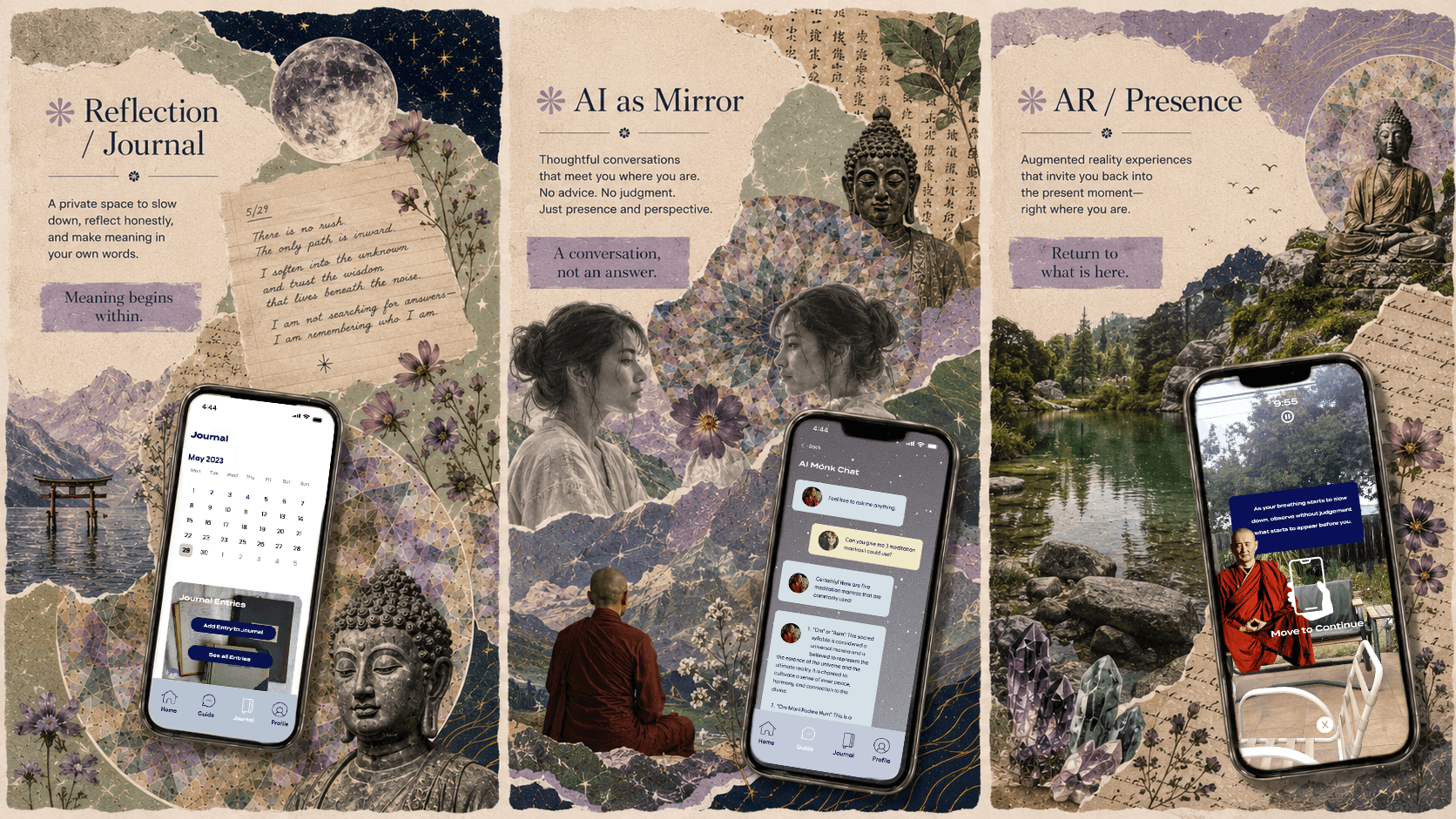
Soulidoscope is a private reflection app that combines journaling, symbolic exploration, optional AI conversations, and augmented reality experiences.
Core Features
Guided Reflection
Open-ended prompts create space for private reflection without pressure to reach a conclusion.
Symbolic Exploration
Abstract visuals and spiritual content invite users to explore ideas through their own interpretation.
Personal Archive
A private journal helps users revisit reflections and notice patterns over time.


Final Product
Soulidoscope is a private reflection app that combines journaling, symbolic exploration, optional AI conversations, and augmented reality experiences.
Core Features
Guided Reflection
Open-ended prompts create space for private reflection without pressure to reach a conclusion.
Symbolic Exploration
Abstract visuals and spiritual content invite users to explore ideas through their own interpretation.
Personal Archive
A private journal helps users revisit reflections and notice patterns over time.
From Early Ideas to Final Interfaces
I translated the selected concept into the product's information architecture, user flows, and wireframes, refining early ideas into a clear, self-directed experience.
From Early Ideas to Final Interfaces
I translated the selected concept into the product's information architecture, user flows, and wireframes, refining early ideas into a clear, self-directed experience.
From Early Ideas to Final Interfaces
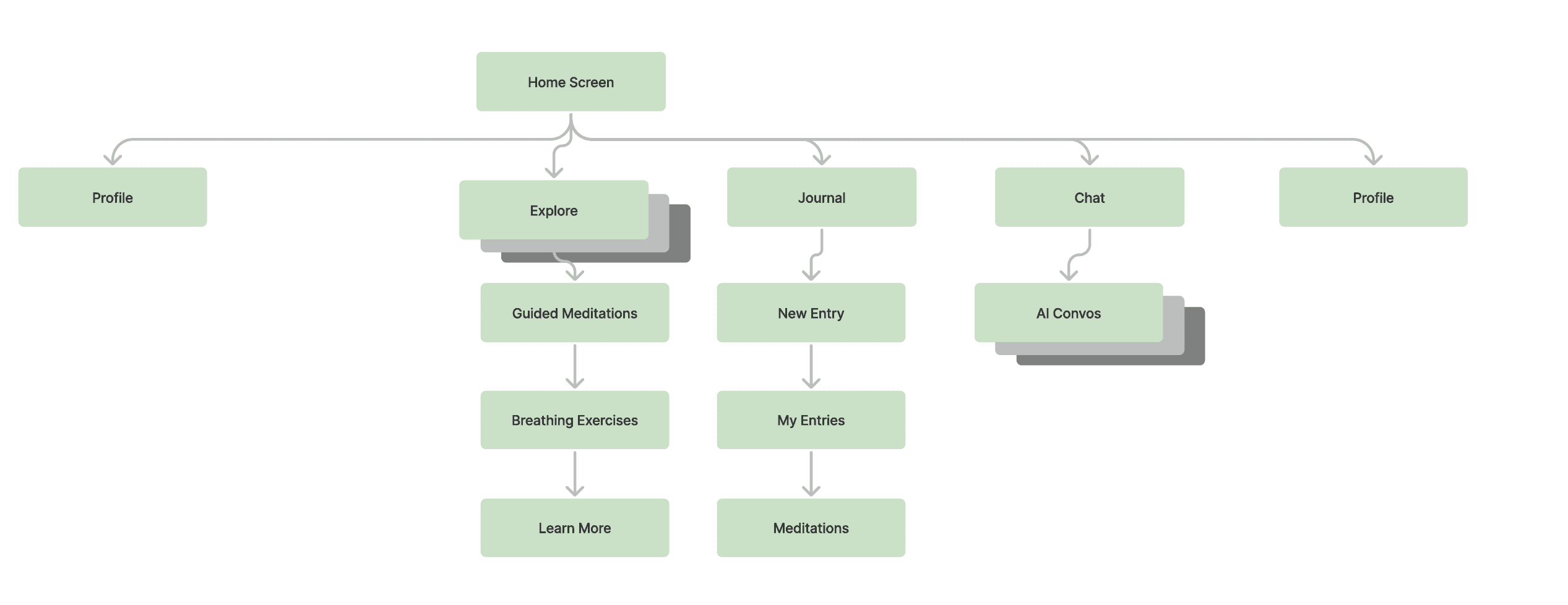
Organized Soulidoscope's information architecture to support reflection, guidance, and exploration, creating a navigation system that feels simple, intentional, and easy to follow.

Mapped two user journeys to ensure AI conversations, AR meditation, and journaling work together as a cohesive reflective experience rather than isolated features.
Mapped two user journeys to ensure AI conversations, AR meditation, and journaling work together as a cohesive reflective experience rather than isolated features.
Organized Soulidoscope's information architecture to support reflection, guidance, and exploration, creating a navigation system that feels simple, intentional, and easy to follow.
Final Product
Soulidoscope is a private reflection app that combines journaling, symbolic exploration, optional AI conversations, and augmented reality experiences.
Core Features
Guided Reflection
Open-ended prompts create space for private reflection without pressure to reach a conclusion.
Symbolic Exploration
Abstract visuals and spiritual content invite users to explore ideas through their own interpretation.
Personal Archive
A private journal helps users revisit reflections and notice patterns over time.
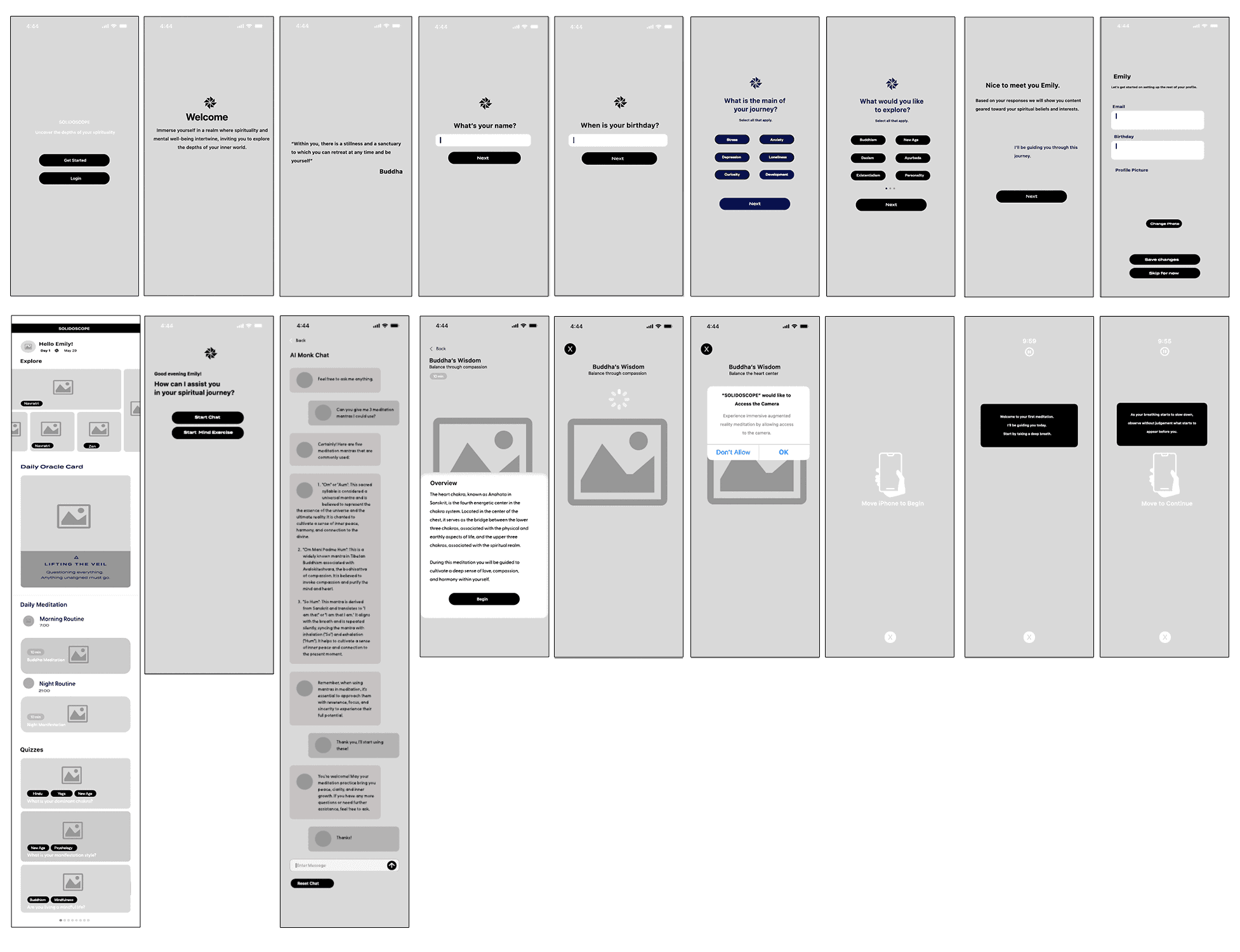

Organized Soulidoscope's information architecture to support reflection, guidance, and exploration, creating a navigation system that feels simple, intentional, and easy to follow.
Mapped two user journeys to ensure AI conversations, AR meditation, and journaling work together as a cohesive reflective experience rather than isolated features.
Ethical Considerations
Because Soulidoscope explores deeply personal experiences, ethical considerations shaped the product from the very beginning.
Rather than asking what AI could do, I focused on what it should do. Several design decisions emerged from that philosophy.
These decisions helped ensure the product remained aligned with its original purpose: supporting reflection without directing it.
Final Product
Soulidoscope is a private reflection app that combines journaling, symbolic exploration, optional AI conversations, and augmented reality experiences.
Core Features
Guided Reflection
Open-ended prompts create space for private reflection without pressure to reach a conclusion.
Symbolic Exploration
Abstract visuals and spiritual content invite users to explore ideas through their own interpretation.
Personal Archive
A private journal helps users revisit reflections and notice patterns over time.


Ethical Considerations
Because Soulidoscope explores deeply personal experiences, ethical considerations shaped the product from the very beginning.
Rather than asking what AI could do, I focused on what it should do. Several design decisions emerged from that philosophy.
These decisions helped ensure the product remained aligned with its original purpose: supporting reflection without directing it.
Reflection
Soulidoscope began as an exploratory concept informed by user interviews, secondary research, competitive analysis, affinity mapping, and persona development.
While those insights shaped the initial direction, future iterations would expand the research through additional participant interviews, prototype testing, and usability studies to validate assumptions and refine the experience.
More than an exploration of AI, this project reflects my approach to design.
I'm drawn to problems where people are navigating complexity, uncertainty, or important decisions. Whether designing civic services, enterprise products, or emerging technologies, I believe thoughtful design should simplify systems while preserving the autonomy of the people using them.
The best technology doesn't replace human judgment. It creates the conditions for people to exercise it with greater confidence.

Ethical Considerations
Because Soulidoscope explores deeply personal experiences, ethical considerations shaped the product from the very beginning.
Rather than asking what AI could do, I focused on what it should do. Several design decisions emerged from that philosophy.
These decisions helped ensure the product remained aligned with its original purpose: supporting reflection without directing it.
Ethical Considerations
Because Soulidoscope explores deeply personal experiences, ethical considerations shaped the product from the very beginning.
Rather than asking what AI could do, I focused on what it should do. Several design decisions emerged from that philosophy.
These decisions helped ensure the product remained aligned with its original purpose: supporting reflection without directing it.
Reflection
Soulidoscope began as an exploratory concept informed by user interviews, secondary research, competitive analysis, affinity mapping, and persona development.
While those insights shaped the initial direction, future iterations would expand the research through additional participant interviews, prototype testing, and usability studies to validate assumptions and refine the experience.
More than an exploration of AI, this project reflects my approach to design.
I'm drawn to problems where people are navigating complexity, uncertainty, or important decisions. Whether designing civic services, enterprise products, or emerging technologies, I believe thoughtful design should simplify systems while preserving the autonomy of the people using them.
The best technology doesn't replace human judgment. It creates the conditions for people to exercise it with greater confidence.
Reflection
Soulidoscope began as an exploratory concept informed by user interviews, secondary research, competitive analysis, affinity mapping, and persona development.
While those insights shaped the initial direction, future iterations would expand the research through additional participant interviews, prototype testing, and usability studies to validate assumptions and refine the experience.
More than an exploration of AI, this project reflects my approach to design.
I'm drawn to problems where people are navigating complexity, uncertainty, or important decisions. Whether designing civic services, enterprise products, or emerging technologies, I believe thoughtful design should simplify systems while preserving the autonomy of the people using them.
The best technology doesn't replace human judgment. It creates the conditions for people to exercise it with greater confidence.
Reflection
Soulidoscope began as an exploratory concept informed by user interviews, secondary research, competitive analysis, affinity mapping, and persona development.
While those insights shaped the initial direction, future iterations would expand the research through additional participant interviews, prototype testing, and usability studies to validate assumptions and refine the experience.
More than an exploration of AI, this project reflects my approach to design.
I'm drawn to problems where people are navigating complexity, uncertainty, or important decisions. Whether designing civic services, enterprise products, or emerging technologies, I believe thoughtful design should simplify systems while preserving the autonomy of the people using them.
The best technology doesn't replace human judgment. It creates the conditions for people to exercise it with greater confidence.



Soulidoscope
Soulidoscope
Exploring How AI and Augmented Reality Can Support Reflection Without Replacing Human Meaning Concept Product Design · UX Research · Interaction Design · Ethical AI · Emerging Technology
My Role
UX Designer · UX Researcher
Qualitative insight · Design principles · Concept prototyping
Methods
Timeline
3 months
Focus
Identity Formation · Reflective Design · Ethical AI
Organization
San Diego County,
Public Health Services
Scope
·5 trainings
· 8 PHS branches
· 812 total staff
Focus
· Racial equity
· Workforce development
· Community health
Overview
Soulidoscope is a conceptual reflection app for young adults exploring identity, spirituality, beliefs, and personal meaning.
The project began with a question: how might technology create room for uncertainty and self-discovery without taking over the work of interpretation?
Rather than designing another wellness or productivity tool, I explored how AI and augmented reality could support curiosity, contemplation, and self-directed reflection.
Research
To understand how young adults approach reflection, spirituality, and personal growth, I combined primary and secondary research before exploring potential product directions.
I conducted two semi-structured interviews focused on self-reflection, spirituality, and experiences with existing wellness tools. I synthesized these conversations through affinity mapping and developed two personas representing different approaches to identity exploration.
To broaden these findings, I also reviewed wellness, journaling, meditation, and AI-assisted products through secondary research and competitive analysis.
Across these methods, four themes consistently emerged:
Existing products often emphasized optimization through goals, streaks, or metrics.
AI was frequently positioned as a guide or interpreter.
Participants valued opportunities to reflect but wanted to remain the primary interpreters of their own experiences.
Few products treated uncertainty as a meaningful part of personal growth.
These insights established the opportunity for a more open-ended and user-directed reflective experience.
The Challenge
For many young adults, identity formation is an ongoing process of questioning beliefs, exploring values, and searching for meaning.
This process is often uncertain, nonlinear, and deeply personal. It requires space to reflect without being pushed toward a predefined answer.
Yet many digital wellness products approach personal growth through optimization. They measure progress, recommend habits, and increasingly rely on AI to interpret how users think or feel.
While these approaches can be valuable, they can also position technology as the authority over experiences that users should be able to interpret for themselves.
How might AI and augmented reality support reflection while preserving the user's role as the primary interpreter of their own meaning?
Concept Exploration
Based on the research, I explored three possible product directions before defining the final concept.
AI Mentor: An AI companion capable of providing guidance and interpretation.
Why it was rejected: This direction positioned AI as an authority over the user's experience.
Mood Tracker: A reflective journal centered on emotional tracking and self-improvement.
Why it was rejected: This approach shifted the experience toward optimization rather than curiosity.
Reflection Companion: A private experience centered on journaling, symbolic interactions, optional AI conversations, and moments of augmented reality.
Why it was selected: This direction best aligned with the project's central philosophy: technology should support reflection without replacing personal interpretation.
Design Evolution
Before designing interfaces, I established four principles to guide every product decision.
Agency over Authority: AI supports reflection without defining meaning.
Reflection over Optimization: The experience avoids streaks, scores, and achievement systems.
Symbolism over Prescription: Interactions invite interpretation rather than predetermined conclusions.
Transparency over Certainty: AI capabilities and limitations remain clear throughout the experience.
These principles informed the decisions below:
Research Insight | Design Response |
|---|---|
Users wanted space for personal interpretation. | AI never interprets journal entries or emotions. |
Existing apps felt overly prescriptive. | Reflection prompts remain intentionally open-ended. |
Participants disliked optimization metrics. | No streaks, badges, or progress scores were included. |
Trust depended on transparency. | AI capabilities and limitations are communicated throughout the experience. |
Reflection felt deeply personal. | Journal entries remain private by default. |
Research
To understand how young adults approach reflection, spirituality, and personal growth, I combined primary and secondary research before exploring potential product directions.
I conducted two semi-structured interviews focused on self-reflection, spirituality, and experiences with existing wellness tools. I synthesized these conversations through affinity mapping and developed two personas representing different approaches to identity exploration.
To broaden these findings, I also reviewed wellness, journaling, meditation, and AI-assisted products through secondary research and competitive analysis.
Across these methods, four themes consistently emerged:
Existing products often emphasized optimization through goals, streaks, or metrics.
AI was frequently positioned as a guide or interpreter.
Participants valued opportunities to reflect but wanted to remain the primary interpreters of their own experiences.
Few products treated uncertainty as a meaningful part of personal growth.
These insights established the opportunity for a more open-ended and user-directed reflective experience.
Concept Exploration
Based on the research, I explored three possible product directions before defining the final concept.
AI Mentor: An AI companion capable of providing guidance and interpretation.
Why it was rejected: This direction positioned AI as an authority over the user's experience.
Mood Tracker: A reflective journal centered on emotional tracking and self-improvement.
Why it was rejected: This approach shifted the experience toward optimization rather than curiosity.
Reflection Companion: A private experience centered on journaling, symbolic interactions, optional AI conversations, and moments of augmented reality.
Why it was selected: This direction best aligned with the project's central philosophy: technology should support reflection without replacing personal interpretation.
Design Evolution
Before designing interfaces, I established four principles to guide every product decision.
Agency over Authority: AI supports reflection without defining meaning.
Reflection over Optimization: The experience avoids streaks, scores, and achievement systems.
Symbolism over Prescription: Interactions invite interpretation rather than predetermined conclusions.
Transparency over Certainty: AI capabilities and limitations remain clear throughout the experience.
These principles informed the decisions below:
Research Insight | Design Response |
|---|---|
Users wanted space for personal interpretation. | AI never interprets journal entries or emotions. |
Existing apps felt overly prescriptive. | Reflection prompts remain intentionally open-ended. |
Participants disliked optimization metrics. | No streaks, badges, or progress scores were included. |
Trust depended on transparency. | AI capabilities and limitations are communicated throughout the experience. |
Reflection felt deeply personal. | Journal entries remain private by default. |
From Early Ideas to Final Interfaces
I translated the selected concept into the product's information architecture, user flows, and wireframes, refining early ideas into a clear, self-directed experience.
Design Evolution
Before designing interfaces, I established four principles to guide every product decision.
Agency over Authority: AI supports reflection without defining meaning.
Reflection over Optimization: The experience avoids streaks, scores, and achievement systems.
Symbolism over Prescription: Interactions invite interpretation rather than predetermined conclusions.
Transparency over Certainty: AI capabilities and limitations remain clear throughout the experience.
These principles informed the decisions below:
Research Insight | Design Response |
|---|---|
Users wanted space for personal interpretation. | AI never interprets journal entries or emotions. |
Existing apps felt overly prescriptive. | Reflection prompts remain intentionally open-ended. |
Participants disliked optimization metrics. | No streaks, badges, or progress scores were included. |
Trust depended on transparency. | AI capabilities and limitations are communicated throughout the experience. |
Reflection felt deeply personal. | Journal entries remain private by default. |
From Early Ideas to Final Interfaces
Design Evolution
Before designing interfaces, I established four principles to guide every product decision.
Agency over Authority: AI supports reflection without defining meaning.
Reflection over Optimization: The experience avoids streaks, scores, and achievement systems.
Symbolism over Prescription: Interactions invite interpretation rather than predetermined conclusions.
Transparency over Certainty: AI capabilities and limitations remain clear throughout the experience.
These principles informed the decisions below:
Research Insight | Design Response |
|---|---|
Users wanted space for personal interpretation. | AI never interprets journal entries or emotions. |
Existing apps felt overly prescriptive. | Reflection prompts remain intentionally open-ended. |
Participants disliked optimization metrics. | No streaks, badges, or progress scores were included. |
Trust depended on transparency. | AI capabilities and limitations are communicated throughout the experience. |
Reflection felt deeply personal. | Journal entries remain private by default. |
Final Product
Soulidoscope is a private reflection app that combines journaling, symbolic exploration, optional AI conversations, and augmented reality experiences.
Core Features
Guided Reflection
Open-ended prompts create space for private reflection without pressure to reach a conclusion.
Symbolic Exploration
Abstract visuals and spiritual content invite users to explore ideas through their own interpretation.
Personal Archive
A private journal helps users revisit reflections and notice patterns over time.
Final Product
Soulidoscope is a private reflection app that combines journaling, symbolic exploration, optional AI conversations, and augmented reality experiences.
Core Features
Guided Reflection
Open-ended prompts create space for private reflection without pressure to reach a conclusion.
Symbolic Exploration
Abstract visuals and spiritual content invite users to explore ideas through their own interpretation.
Personal Archive
A private journal helps users revisit reflections and notice patterns over time.
From Early Ideas to Final Interfaces
I translated the selected concept into the product's information architecture, user flows, and wireframes, refining early ideas into a clear, self-directed experience.
From Early Ideas to Final Interfaces
I translated the selected concept into the product's information architecture, user flows, and wireframes, refining early ideas into a clear, self-directed experience.
From Early Ideas to Final Interfaces
Organized Soulidoscope's information architecture to support reflection, guidance, and exploration, creating a navigation system that feels simple, intentional, and easy to follow.
Mapped two user journeys to ensure AI conversations, AR meditation, and journaling work together as a cohesive reflective experience rather than isolated features.
Mapped two user journeys to ensure AI conversations, AR meditation, and journaling work together as a cohesive reflective experience rather than isolated features.
Organized Soulidoscope's information architecture to support reflection, guidance, and exploration, creating a navigation system that feels simple, intentional, and easy to follow.
Final Product
Soulidoscope is a private reflection app that combines journaling, symbolic exploration, optional AI conversations, and augmented reality experiences.
Core Features
Guided Reflection
Open-ended prompts create space for private reflection without pressure to reach a conclusion.
Symbolic Exploration
Abstract visuals and spiritual content invite users to explore ideas through their own interpretation.
Personal Archive
A private journal helps users revisit reflections and notice patterns over time.
Organized Soulidoscope's information architecture to support reflection, guidance, and exploration, creating a navigation system that feels simple, intentional, and easy to follow.
Mapped two user journeys to ensure AI conversations, AR meditation, and journaling work together as a cohesive reflective experience rather than isolated features.
Ethical Considerations
Because Soulidoscope explores deeply personal experiences, ethical considerations shaped the product from the very beginning.
Rather than asking what AI could do, I focused on what it should do. Several design decisions emerged from that philosophy.
These decisions helped ensure the product remained aligned with its original purpose: supporting reflection without directing it.
Final Product
Soulidoscope is a private reflection app that combines journaling, symbolic exploration, optional AI conversations, and augmented reality experiences.
Core Features
Guided Reflection
Open-ended prompts create space for private reflection without pressure to reach a conclusion.
Symbolic Exploration
Abstract visuals and spiritual content invite users to explore ideas through their own interpretation.
Personal Archive
A private journal helps users revisit reflections and notice patterns over time.
Ethical Considerations
Because Soulidoscope explores deeply personal experiences, ethical considerations shaped the product from the very beginning.
Rather than asking what AI could do, I focused on what it should do. Several design decisions emerged from that philosophy.
These decisions helped ensure the product remained aligned with its original purpose: supporting reflection without directing it.
Reflection
Soulidoscope began as an exploratory concept informed by user interviews, secondary research, competitive analysis, affinity mapping, and persona development.
While those insights shaped the initial direction, future iterations would expand the research through additional participant interviews, prototype testing, and usability studies to validate assumptions and refine the experience.
More than an exploration of AI, this project reflects my approach to design.
I'm drawn to problems where people are navigating complexity, uncertainty, or important decisions. Whether designing civic services, enterprise products, or emerging technologies, I believe thoughtful design should simplify systems while preserving the autonomy of the people using them.
The best technology doesn't replace human judgment. It creates the conditions for people to exercise it with greater confidence.
Ethical Considerations
Because Soulidoscope explores deeply personal experiences, ethical considerations shaped the product from the very beginning.
Rather than asking what AI could do, I focused on what it should do. Several design decisions emerged from that philosophy.
These decisions helped ensure the product remained aligned with its original purpose: supporting reflection without directing it.
Ethical Considerations
Because Soulidoscope explores deeply personal experiences, ethical considerations shaped the product from the very beginning.
Rather than asking what AI could do, I focused on what it should do. Several design decisions emerged from that philosophy.
These decisions helped ensure the product remained aligned with its original purpose: supporting reflection without directing it.
Reflection
Soulidoscope began as an exploratory concept informed by user interviews, secondary research, competitive analysis, affinity mapping, and persona development.
While those insights shaped the initial direction, future iterations would expand the research through additional participant interviews, prototype testing, and usability studies to validate assumptions and refine the experience.
More than an exploration of AI, this project reflects my approach to design.
I'm drawn to problems where people are navigating complexity, uncertainty, or important decisions. Whether designing civic services, enterprise products, or emerging technologies, I believe thoughtful design should simplify systems while preserving the autonomy of the people using them.
The best technology doesn't replace human judgment. It creates the conditions for people to exercise it with greater confidence.
Reflection
Soulidoscope began as an exploratory concept informed by user interviews, secondary research, competitive analysis, affinity mapping, and persona development.
While those insights shaped the initial direction, future iterations would expand the research through additional participant interviews, prototype testing, and usability studies to validate assumptions and refine the experience.
More than an exploration of AI, this project reflects my approach to design.
I'm drawn to problems where people are navigating complexity, uncertainty, or important decisions. Whether designing civic services, enterprise products, or emerging technologies, I believe thoughtful design should simplify systems while preserving the autonomy of the people using them.
The best technology doesn't replace human judgment. It creates the conditions for people to exercise it with greater confidence.
Reflection
Soulidoscope began as an exploratory concept informed by user interviews, secondary research, competitive analysis, affinity mapping, and persona development.
While those insights shaped the initial direction, future iterations would expand the research through additional participant interviews, prototype testing, and usability studies to validate assumptions and refine the experience.
More than an exploration of AI, this project reflects my approach to design.
I'm drawn to problems where people are navigating complexity, uncertainty, or important decisions. Whether designing civic services, enterprise products, or emerging technologies, I believe thoughtful design should simplify systems while preserving the autonomy of the people using them.
The best technology doesn't replace human judgment. It creates the conditions for people to exercise it with greater confidence.
Soulidoscope
Soulidoscope
Exploring How AI and Augmented Reality Can Support Reflection Without Replacing Human Meaning Concept Product Design · UX Research · Interaction Design · Ethical AI · Emerging Technology
My Role
UX Designer · UX Researcher
Qualitative insight · Design principles · Concept prototyping
Methods
Timeline
3 months
Focus
Identity Formation · Reflective Design · Ethical AI
Organization
San Diego County,
Public Health Services
Scope
·5 trainings
· 8 PHS branches
· 812 total staff
Focus
· Racial equity
· Workforce development
· Community health
Overview
Soulidoscope is a conceptual reflection app for young adults exploring identity, spirituality, beliefs, and personal meaning.
The project began with a question: how might technology create room for uncertainty and self-discovery without taking over the work of interpretation?
Rather than designing another wellness or productivity tool, I explored how AI and augmented reality could support curiosity, contemplation, and self-directed reflection.
Research
To understand how young adults approach reflection, spirituality, and personal growth, I combined primary and secondary research before exploring potential product directions.
I conducted two semi-structured interviews focused on self-reflection, spirituality, and experiences with existing wellness tools. I synthesized these conversations through affinity mapping and developed two personas representing different approaches to identity exploration.
To broaden these findings, I also reviewed wellness, journaling, meditation, and AI-assisted products through secondary research and competitive analysis.
Across these methods, four themes consistently emerged:
Existing products often emphasized optimization through goals, streaks, or metrics.
AI was frequently positioned as a guide or interpreter.
Participants valued opportunities to reflect but wanted to remain the primary interpreters of their own experiences.
Few products treated uncertainty as a meaningful part of personal growth.
These insights established the opportunity for a more open-ended and user-directed reflective experience.
The Challenge
For many young adults, identity formation is an ongoing process of questioning beliefs, exploring values, and searching for meaning.
This process is often uncertain, nonlinear, and deeply personal. It requires space to reflect without being pushed toward a predefined answer.
Yet many digital wellness products approach personal growth through optimization. They measure progress, recommend habits, and increasingly rely on AI to interpret how users think or feel.
While these approaches can be valuable, they can also position technology as the authority over experiences that users should be able to interpret for themselves.
How might AI and augmented reality support reflection while preserving the user's role as the primary interpreter of their own meaning?
Concept Exploration
Based on the research, I explored three possible product directions before defining the final concept.
AI Mentor: An AI companion capable of providing guidance and interpretation.
Why it was rejected: This direction positioned AI as an authority over the user's experience.
Mood Tracker: A reflective journal centered on emotional tracking and self-improvement.
Why it was rejected: This approach shifted the experience toward optimization rather than curiosity.
Reflection Companion: A private experience centered on journaling, symbolic interactions, optional AI conversations, and moments of augmented reality.
Why it was selected: This direction best aligned with the project's central philosophy: technology should support reflection without replacing personal interpretation.
Design Evolution
Before designing interfaces, I established four principles to guide every product decision.
Agency over Authority: AI supports reflection without defining meaning.
Reflection over Optimization: The experience avoids streaks, scores, and achievement systems.
Symbolism over Prescription: Interactions invite interpretation rather than predetermined conclusions.
Transparency over Certainty: AI capabilities and limitations remain clear throughout the experience.
These principles informed the decisions below:
Research Insight | Design Response |
|---|---|
Users wanted space for personal interpretation. | AI never interprets journal entries or emotions. |
Existing apps felt overly prescriptive. | Reflection prompts remain intentionally open-ended. |
Participants disliked optimization metrics. | No streaks, badges, or progress scores were included. |
Trust depended on transparency. | AI capabilities and limitations are communicated throughout the experience. |
Reflection felt deeply personal. | Journal entries remain private by default. |
Research
To understand how young adults approach reflection, spirituality, and personal growth, I combined primary and secondary research before exploring potential product directions.
I conducted two semi-structured interviews focused on self-reflection, spirituality, and experiences with existing wellness tools. I synthesized these conversations through affinity mapping and developed two personas representing different approaches to identity exploration.
To broaden these findings, I also reviewed wellness, journaling, meditation, and AI-assisted products through secondary research and competitive analysis.
Across these methods, four themes consistently emerged:
Existing products often emphasized optimization through goals, streaks, or metrics.
AI was frequently positioned as a guide or interpreter.
Participants valued opportunities to reflect but wanted to remain the primary interpreters of their own experiences.
Few products treated uncertainty as a meaningful part of personal growth.
These insights established the opportunity for a more open-ended and user-directed reflective experience.
Concept Exploration
Based on the research, I explored three possible product directions before defining the final concept.
AI Mentor: An AI companion capable of providing guidance and interpretation.
Why it was rejected: This direction positioned AI as an authority over the user's experience.
Mood Tracker: A reflective journal centered on emotional tracking and self-improvement.
Why it was rejected: This approach shifted the experience toward optimization rather than curiosity.
Reflection Companion: A private experience centered on journaling, symbolic interactions, optional AI conversations, and moments of augmented reality.
Why it was selected: This direction best aligned with the project's central philosophy: technology should support reflection without replacing personal interpretation.
Design Evolution
Before designing interfaces, I established four principles to guide every product decision.
Agency over Authority: AI supports reflection without defining meaning.
Reflection over Optimization: The experience avoids streaks, scores, and achievement systems.
Symbolism over Prescription: Interactions invite interpretation rather than predetermined conclusions.
Transparency over Certainty: AI capabilities and limitations remain clear throughout the experience.
These principles informed the decisions below:
Research Insight | Design Response |
|---|---|
Users wanted space for personal interpretation. | AI never interprets journal entries or emotions. |
Existing apps felt overly prescriptive. | Reflection prompts remain intentionally open-ended. |
Participants disliked optimization metrics. | No streaks, badges, or progress scores were included. |
Trust depended on transparency. | AI capabilities and limitations are communicated throughout the experience. |
Reflection felt deeply personal. | Journal entries remain private by default. |
From Early Ideas to Final Interfaces
I translated the selected concept into the product's information architecture, user flows, and wireframes, refining early ideas into a clear, self-directed experience.
Design Evolution
Before designing interfaces, I established four principles to guide every product decision.
Agency over Authority: AI supports reflection without defining meaning.
Reflection over Optimization: The experience avoids streaks, scores, and achievement systems.
Symbolism over Prescription: Interactions invite interpretation rather than predetermined conclusions.
Transparency over Certainty: AI capabilities and limitations remain clear throughout the experience.
These principles informed the decisions below:
Research Insight | Design Response |
|---|---|
Users wanted space for personal interpretation. | AI never interprets journal entries or emotions. |
Existing apps felt overly prescriptive. | Reflection prompts remain intentionally open-ended. |
Participants disliked optimization metrics. | No streaks, badges, or progress scores were included. |
Trust depended on transparency. | AI capabilities and limitations are communicated throughout the experience. |
Reflection felt deeply personal. | Journal entries remain private by default. |
From Early Ideas to Final Interfaces
Design Evolution
Before designing interfaces, I established four principles to guide every product decision.
Agency over Authority: AI supports reflection without defining meaning.
Reflection over Optimization: The experience avoids streaks, scores, and achievement systems.
Symbolism over Prescription: Interactions invite interpretation rather than predetermined conclusions.
Transparency over Certainty: AI capabilities and limitations remain clear throughout the experience.
These principles informed the decisions below:
Research Insight | Design Response |
|---|---|
Users wanted space for personal interpretation. | AI never interprets journal entries or emotions. |
Existing apps felt overly prescriptive. | Reflection prompts remain intentionally open-ended. |
Participants disliked optimization metrics. | No streaks, badges, or progress scores were included. |
Trust depended on transparency. | AI capabilities and limitations are communicated throughout the experience. |
Reflection felt deeply personal. | Journal entries remain private by default. |
Final Product
Soulidoscope is a private reflection app that combines journaling, symbolic exploration, optional AI conversations, and augmented reality experiences.
Core Features
Guided Reflection
Open-ended prompts create space for private reflection without pressure to reach a conclusion.
Symbolic Exploration
Abstract visuals and spiritual content invite users to explore ideas through their own interpretation.
Personal Archive
A private journal helps users revisit reflections and notice patterns over time.
Final Product
Soulidoscope is a private reflection app that combines journaling, symbolic exploration, optional AI conversations, and augmented reality experiences.
Core Features
Guided Reflection
Open-ended prompts create space for private reflection without pressure to reach a conclusion.
Symbolic Exploration
Abstract visuals and spiritual content invite users to explore ideas through their own interpretation.
Personal Archive
A private journal helps users revisit reflections and notice patterns over time.
From Early Ideas to Final Interfaces
I translated the selected concept into the product's information architecture, user flows, and wireframes, refining early ideas into a clear, self-directed experience.
From Early Ideas to Final Interfaces
I translated the selected concept into the product's information architecture, user flows, and wireframes, refining early ideas into a clear, self-directed experience.
From Early Ideas to Final Interfaces
Organized Soulidoscope's information architecture to support reflection, guidance, and exploration, creating a navigation system that feels simple, intentional, and easy to follow.
Mapped two user journeys to ensure AI conversations, AR meditation, and journaling work together as a cohesive reflective experience rather than isolated features.
Mapped two user journeys to ensure AI conversations, AR meditation, and journaling work together as a cohesive reflective experience rather than isolated features.
Organized Soulidoscope's information architecture to support reflection, guidance, and exploration, creating a navigation system that feels simple, intentional, and easy to follow.
Final Product
Soulidoscope is a private reflection app that combines journaling, symbolic exploration, optional AI conversations, and augmented reality experiences.
Core Features
Guided Reflection
Open-ended prompts create space for private reflection without pressure to reach a conclusion.
Symbolic Exploration
Abstract visuals and spiritual content invite users to explore ideas through their own interpretation.
Personal Archive
A private journal helps users revisit reflections and notice patterns over time.
Organized Soulidoscope's information architecture to support reflection, guidance, and exploration, creating a navigation system that feels simple, intentional, and easy to follow.
Mapped two user journeys to ensure AI conversations, AR meditation, and journaling work together as a cohesive reflective experience rather than isolated features.
Ethical Considerations
Because Soulidoscope explores deeply personal experiences, ethical considerations shaped the product from the very beginning.
Rather than asking what AI could do, I focused on what it should do. Several design decisions emerged from that philosophy.
These decisions helped ensure the product remained aligned with its original purpose: supporting reflection without directing it.
Final Product
Soulidoscope is a private reflection app that combines journaling, symbolic exploration, optional AI conversations, and augmented reality experiences.
Core Features
Guided Reflection
Open-ended prompts create space for private reflection without pressure to reach a conclusion.
Symbolic Exploration
Abstract visuals and spiritual content invite users to explore ideas through their own interpretation.
Personal Archive
A private journal helps users revisit reflections and notice patterns over time.
Ethical Considerations
Because Soulidoscope explores deeply personal experiences, ethical considerations shaped the product from the very beginning.
Rather than asking what AI could do, I focused on what it should do. Several design decisions emerged from that philosophy.
These decisions helped ensure the product remained aligned with its original purpose: supporting reflection without directing it.
Reflection
Soulidoscope began as an exploratory concept informed by user interviews, secondary research, competitive analysis, affinity mapping, and persona development.
While those insights shaped the initial direction, future iterations would expand the research through additional participant interviews, prototype testing, and usability studies to validate assumptions and refine the experience.
More than an exploration of AI, this project reflects my approach to design.
I'm drawn to problems where people are navigating complexity, uncertainty, or important decisions. Whether designing civic services, enterprise products, or emerging technologies, I believe thoughtful design should simplify systems while preserving the autonomy of the people using them.
The best technology doesn't replace human judgment. It creates the conditions for people to exercise it with greater confidence.
Ethical Considerations
Because Soulidoscope explores deeply personal experiences, ethical considerations shaped the product from the very beginning.
Rather than asking what AI could do, I focused on what it should do. Several design decisions emerged from that philosophy.
These decisions helped ensure the product remained aligned with its original purpose: supporting reflection without directing it.
Ethical Considerations
Because Soulidoscope explores deeply personal experiences, ethical considerations shaped the product from the very beginning.
Rather than asking what AI could do, I focused on what it should do. Several design decisions emerged from that philosophy.
These decisions helped ensure the product remained aligned with its original purpose: supporting reflection without directing it.
Reflection
Soulidoscope began as an exploratory concept informed by user interviews, secondary research, competitive analysis, affinity mapping, and persona development.
While those insights shaped the initial direction, future iterations would expand the research through additional participant interviews, prototype testing, and usability studies to validate assumptions and refine the experience.
More than an exploration of AI, this project reflects my approach to design.
I'm drawn to problems where people are navigating complexity, uncertainty, or important decisions. Whether designing civic services, enterprise products, or emerging technologies, I believe thoughtful design should simplify systems while preserving the autonomy of the people using them.
The best technology doesn't replace human judgment. It creates the conditions for people to exercise it with greater confidence.
Reflection
Soulidoscope began as an exploratory concept informed by user interviews, secondary research, competitive analysis, affinity mapping, and persona development.
While those insights shaped the initial direction, future iterations would expand the research through additional participant interviews, prototype testing, and usability studies to validate assumptions and refine the experience.
More than an exploration of AI, this project reflects my approach to design.
I'm drawn to problems where people are navigating complexity, uncertainty, or important decisions. Whether designing civic services, enterprise products, or emerging technologies, I believe thoughtful design should simplify systems while preserving the autonomy of the people using them.
The best technology doesn't replace human judgment. It creates the conditions for people to exercise it with greater confidence.
Reflection
Soulidoscope began as an exploratory concept informed by user interviews, secondary research, competitive analysis, affinity mapping, and persona development.
While those insights shaped the initial direction, future iterations would expand the research through additional participant interviews, prototype testing, and usability studies to validate assumptions and refine the experience.
More than an exploration of AI, this project reflects my approach to design.
I'm drawn to problems where people are navigating complexity, uncertainty, or important decisions. Whether designing civic services, enterprise products, or emerging technologies, I believe thoughtful design should simplify systems while preserving the autonomy of the people using them.
The best technology doesn't replace human judgment. It creates the conditions for people to exercise it with greater confidence.
Soulidoscope
Soulidoscope
Exploring How AI and Augmented Reality Can Support Reflection Without Replacing Human Meaning Concept Product Design · UX Research · Interaction Design · Ethical AI · Emerging Technology
My Role
UX Designer · UX Researcher
Qualitative insight · Design principles · Concept prototyping
Methods
Timeline
3 months
Focus
Identity Formation · Reflective Design · Ethical AI
Organization
San Diego County,
Public Health Services
Scope
·5 trainings
· 8 PHS branches
· 812 total staff
Focus
· Racial equity
· Workforce development
· Community health
Overview
Soulidoscope is a conceptual reflection app for young adults exploring identity, spirituality, beliefs, and personal meaning.
The project began with a question: how might technology create room for uncertainty and self-discovery without taking over the work of interpretation?
Rather than designing another wellness or productivity tool, I explored how AI and augmented reality could support curiosity, contemplation, and self-directed reflection.
Research
To understand how young adults approach reflection, spirituality, and personal growth, I combined primary and secondary research before exploring potential product directions.
I conducted two semi-structured interviews focused on self-reflection, spirituality, and experiences with existing wellness tools. I synthesized these conversations through affinity mapping and developed two personas representing different approaches to identity exploration.
To broaden these findings, I also reviewed wellness, journaling, meditation, and AI-assisted products through secondary research and competitive analysis.
Across these methods, four themes consistently emerged:
Existing products often emphasized optimization through goals, streaks, or metrics.
AI was frequently positioned as a guide or interpreter.
Participants valued opportunities to reflect but wanted to remain the primary interpreters of their own experiences.
Few products treated uncertainty as a meaningful part of personal growth.
These insights established the opportunity for a more open-ended and user-directed reflective experience.
The Challenge
For many young adults, identity formation is an ongoing process of questioning beliefs, exploring values, and searching for meaning.
This process is often uncertain, nonlinear, and deeply personal. It requires space to reflect without being pushed toward a predefined answer.
Yet many digital wellness products approach personal growth through optimization. They measure progress, recommend habits, and increasingly rely on AI to interpret how users think or feel.
While these approaches can be valuable, they can also position technology as the authority over experiences that users should be able to interpret for themselves.
How might AI and augmented reality support reflection while preserving the user's role as the primary interpreter of their own meaning?
Concept Exploration
Based on the research, I explored three possible product directions before defining the final concept.
AI Mentor: An AI companion capable of providing guidance and interpretation.
Why it was rejected: This direction positioned AI as an authority over the user's experience.
Mood Tracker: A reflective journal centered on emotional tracking and self-improvement.
Why it was rejected: This approach shifted the experience toward optimization rather than curiosity.
Reflection Companion: A private experience centered on journaling, symbolic interactions, optional AI conversations, and moments of augmented reality.
Why it was selected: This direction best aligned with the project's central philosophy: technology should support reflection without replacing personal interpretation.
Design Evolution
Before designing interfaces, I established four principles to guide every product decision.
Agency over Authority: AI supports reflection without defining meaning.
Reflection over Optimization: The experience avoids streaks, scores, and achievement systems.
Symbolism over Prescription: Interactions invite interpretation rather than predetermined conclusions.
Transparency over Certainty: AI capabilities and limitations remain clear throughout the experience.
These principles informed the decisions below:
Research Insight | Design Response |
|---|---|
Users wanted space for personal interpretation. | AI never interprets journal entries or emotions. |
Existing apps felt overly prescriptive. | Reflection prompts remain intentionally open-ended. |
Participants disliked optimization metrics. | No streaks, badges, or progress scores were included. |
Trust depended on transparency. | AI capabilities and limitations are communicated throughout the experience. |
Reflection felt deeply personal. | Journal entries remain private by default. |
Research
To understand how young adults approach reflection, spirituality, and personal growth, I combined primary and secondary research before exploring potential product directions.
I conducted two semi-structured interviews focused on self-reflection, spirituality, and experiences with existing wellness tools. I synthesized these conversations through affinity mapping and developed two personas representing different approaches to identity exploration.
To broaden these findings, I also reviewed wellness, journaling, meditation, and AI-assisted products through secondary research and competitive analysis.
Across these methods, four themes consistently emerged:
Existing products often emphasized optimization through goals, streaks, or metrics.
AI was frequently positioned as a guide or interpreter.
Participants valued opportunities to reflect but wanted to remain the primary interpreters of their own experiences.
Few products treated uncertainty as a meaningful part of personal growth.
These insights established the opportunity for a more open-ended and user-directed reflective experience.
Concept Exploration
Based on the research, I explored three possible product directions before defining the final concept.
AI Mentor: An AI companion capable of providing guidance and interpretation.
Why it was rejected: This direction positioned AI as an authority over the user's experience.
Mood Tracker: A reflective journal centered on emotional tracking and self-improvement.
Why it was rejected: This approach shifted the experience toward optimization rather than curiosity.
Reflection Companion: A private experience centered on journaling, symbolic interactions, optional AI conversations, and moments of augmented reality.
Why it was selected: This direction best aligned with the project's central philosophy: technology should support reflection without replacing personal interpretation.
Design Evolution
Before designing interfaces, I established four principles to guide every product decision.
Agency over Authority: AI supports reflection without defining meaning.
Reflection over Optimization: The experience avoids streaks, scores, and achievement systems.
Symbolism over Prescription: Interactions invite interpretation rather than predetermined conclusions.
Transparency over Certainty: AI capabilities and limitations remain clear throughout the experience.
These principles informed the decisions below:
Research Insight | Design Response |
|---|---|
Users wanted space for personal interpretation. | AI never interprets journal entries or emotions. |
Existing apps felt overly prescriptive. | Reflection prompts remain intentionally open-ended. |
Participants disliked optimization metrics. | No streaks, badges, or progress scores were included. |
Trust depended on transparency. | AI capabilities and limitations are communicated throughout the experience. |
Reflection felt deeply personal. | Journal entries remain private by default. |
From Early Ideas to Final Interfaces
I translated the selected concept into the product's information architecture, user flows, and wireframes, refining early ideas into a clear, self-directed experience.
Design Evolution
Before designing interfaces, I established four principles to guide every product decision.
Agency over Authority: AI supports reflection without defining meaning.
Reflection over Optimization: The experience avoids streaks, scores, and achievement systems.
Symbolism over Prescription: Interactions invite interpretation rather than predetermined conclusions.
Transparency over Certainty: AI capabilities and limitations remain clear throughout the experience.
These principles informed the decisions below:
Research Insight | Design Response |
|---|---|
Users wanted space for personal interpretation. | AI never interprets journal entries or emotions. |
Existing apps felt overly prescriptive. | Reflection prompts remain intentionally open-ended. |
Participants disliked optimization metrics. | No streaks, badges, or progress scores were included. |
Trust depended on transparency. | AI capabilities and limitations are communicated throughout the experience. |
Reflection felt deeply personal. | Journal entries remain private by default. |
From Early Ideas to Final Interfaces
Design Evolution
Before designing interfaces, I established four principles to guide every product decision.
Agency over Authority: AI supports reflection without defining meaning.
Reflection over Optimization: The experience avoids streaks, scores, and achievement systems.
Symbolism over Prescription: Interactions invite interpretation rather than predetermined conclusions.
Transparency over Certainty: AI capabilities and limitations remain clear throughout the experience.
These principles informed the decisions below:
Research Insight | Design Response |
|---|---|
Users wanted space for personal interpretation. | AI never interprets journal entries or emotions. |
Existing apps felt overly prescriptive. | Reflection prompts remain intentionally open-ended. |
Participants disliked optimization metrics. | No streaks, badges, or progress scores were included. |
Trust depended on transparency. | AI capabilities and limitations are communicated throughout the experience. |
Reflection felt deeply personal. | Journal entries remain private by default. |
Final Product
Soulidoscope is a private reflection app that combines journaling, symbolic exploration, optional AI conversations, and augmented reality experiences.
Core Features
Guided Reflection
Open-ended prompts create space for private reflection without pressure to reach a conclusion.
Symbolic Exploration
Abstract visuals and spiritual content invite users to explore ideas through their own interpretation.
Personal Archive
A private journal helps users revisit reflections and notice patterns over time.
Final Product
Soulidoscope is a private reflection app that combines journaling, symbolic exploration, optional AI conversations, and augmented reality experiences.
Core Features
Guided Reflection
Open-ended prompts create space for private reflection without pressure to reach a conclusion.
Symbolic Exploration
Abstract visuals and spiritual content invite users to explore ideas through their own interpretation.
Personal Archive
A private journal helps users revisit reflections and notice patterns over time.
From Early Ideas to Final Interfaces
I translated the selected concept into the product's information architecture, user flows, and wireframes, refining early ideas into a clear, self-directed experience.
From Early Ideas to Final Interfaces
I translated the selected concept into the product's information architecture, user flows, and wireframes, refining early ideas into a clear, self-directed experience.
From Early Ideas to Final Interfaces
Organized Soulidoscope's information architecture to support reflection, guidance, and exploration, creating a navigation system that feels simple, intentional, and easy to follow.
Mapped two user journeys to ensure AI conversations, AR meditation, and journaling work together as a cohesive reflective experience rather than isolated features.
Mapped two user journeys to ensure AI conversations, AR meditation, and journaling work together as a cohesive reflective experience rather than isolated features.
Organized Soulidoscope's information architecture to support reflection, guidance, and exploration, creating a navigation system that feels simple, intentional, and easy to follow.
Final Product
Soulidoscope is a private reflection app that combines journaling, symbolic exploration, optional AI conversations, and augmented reality experiences.
Core Features
Guided Reflection
Open-ended prompts create space for private reflection without pressure to reach a conclusion.
Symbolic Exploration
Abstract visuals and spiritual content invite users to explore ideas through their own interpretation.
Personal Archive
A private journal helps users revisit reflections and notice patterns over time.
Organized Soulidoscope's information architecture to support reflection, guidance, and exploration, creating a navigation system that feels simple, intentional, and easy to follow.
Mapped two user journeys to ensure AI conversations, AR meditation, and journaling work together as a cohesive reflective experience rather than isolated features.
Ethical Considerations
Because Soulidoscope explores deeply personal experiences, ethical considerations shaped the product from the very beginning.
Rather than asking what AI could do, I focused on what it should do. Several design decisions emerged from that philosophy.
These decisions helped ensure the product remained aligned with its original purpose: supporting reflection without directing it.
Final Product
Soulidoscope is a private reflection app that combines journaling, symbolic exploration, optional AI conversations, and augmented reality experiences.
Core Features
Guided Reflection
Open-ended prompts create space for private reflection without pressure to reach a conclusion.
Symbolic Exploration
Abstract visuals and spiritual content invite users to explore ideas through their own interpretation.
Personal Archive
A private journal helps users revisit reflections and notice patterns over time.
Ethical Considerations
Because Soulidoscope explores deeply personal experiences, ethical considerations shaped the product from the very beginning.
Rather than asking what AI could do, I focused on what it should do. Several design decisions emerged from that philosophy.
These decisions helped ensure the product remained aligned with its original purpose: supporting reflection without directing it.
Reflection
Soulidoscope began as an exploratory concept informed by user interviews, secondary research, competitive analysis, affinity mapping, and persona development.
While those insights shaped the initial direction, future iterations would expand the research through additional participant interviews, prototype testing, and usability studies to validate assumptions and refine the experience.
More than an exploration of AI, this project reflects my approach to design.
I'm drawn to problems where people are navigating complexity, uncertainty, or important decisions. Whether designing civic services, enterprise products, or emerging technologies, I believe thoughtful design should simplify systems while preserving the autonomy of the people using them.
The best technology doesn't replace human judgment. It creates the conditions for people to exercise it with greater confidence.
Ethical Considerations
Because Soulidoscope explores deeply personal experiences, ethical considerations shaped the product from the very beginning.
Rather than asking what AI could do, I focused on what it should do. Several design decisions emerged from that philosophy.
These decisions helped ensure the product remained aligned with its original purpose: supporting reflection without directing it.
Ethical Considerations
Because Soulidoscope explores deeply personal experiences, ethical considerations shaped the product from the very beginning.
Rather than asking what AI could do, I focused on what it should do. Several design decisions emerged from that philosophy.
These decisions helped ensure the product remained aligned with its original purpose: supporting reflection without directing it.
Reflection
Soulidoscope began as an exploratory concept informed by user interviews, secondary research, competitive analysis, affinity mapping, and persona development.
While those insights shaped the initial direction, future iterations would expand the research through additional participant interviews, prototype testing, and usability studies to validate assumptions and refine the experience.
More than an exploration of AI, this project reflects my approach to design.
I'm drawn to problems where people are navigating complexity, uncertainty, or important decisions. Whether designing civic services, enterprise products, or emerging technologies, I believe thoughtful design should simplify systems while preserving the autonomy of the people using them.
The best technology doesn't replace human judgment. It creates the conditions for people to exercise it with greater confidence.
Reflection
Soulidoscope began as an exploratory concept informed by user interviews, secondary research, competitive analysis, affinity mapping, and persona development.
While those insights shaped the initial direction, future iterations would expand the research through additional participant interviews, prototype testing, and usability studies to validate assumptions and refine the experience.
More than an exploration of AI, this project reflects my approach to design.
I'm drawn to problems where people are navigating complexity, uncertainty, or important decisions. Whether designing civic services, enterprise products, or emerging technologies, I believe thoughtful design should simplify systems while preserving the autonomy of the people using them.
The best technology doesn't replace human judgment. It creates the conditions for people to exercise it with greater confidence.
Reflection
Soulidoscope began as an exploratory concept informed by user interviews, secondary research, competitive analysis, affinity mapping, and persona development.
While those insights shaped the initial direction, future iterations would expand the research through additional participant interviews, prototype testing, and usability studies to validate assumptions and refine the experience.
More than an exploration of AI, this project reflects my approach to design.
I'm drawn to problems where people are navigating complexity, uncertainty, or important decisions. Whether designing civic services, enterprise products, or emerging technologies, I believe thoughtful design should simplify systems while preserving the autonomy of the people using them.
The best technology doesn't replace human judgment. It creates the conditions for people to exercise it with greater confidence.